






Press play to start listening
Top AI-powered vendor risk platforms for SaaS companies in 2026, compare tools, features, and how to choose the right TPRM solution fast.
Vendor risk is no longer a once-a-year questionnaire. One missed system can become the breach that defines your quarter. When the MOVEit zero-day sliced through supply chains in 2023, many SaaS teams learned that a forgotten SFTP server can dominate tomorrow’s headlines.
Third-party compromises have doubled year over year and now fuel about 30 percent of reported breaches, according to Verizon’s 2025 Data Breach Investigations Report (DBIR). Regulators are moving just as fast.
Europe’s Digital Operational Resilience Act (DORA) began enforcing vendor oversight for financial firms in January 2025, and the SEC’s incident-disclosure rules plus Payment Card Industry Data Security Standard (PCI DSS) 4.0 all ask the same blunt question: how are you monitoring suppliers?
Meanwhile, your stack keeps sprawling. AI APIs, low-code builders, and one-off SaaS add-ons arrive with hidden sub-processors. Shadow AI projects can appear overnight, so your vendor inventory and risk register have to move at the same speed.
That pressure has created a new class of AI-driven vendor-risk platforms. They can digest 100-page SOC 2 (System and Organization Controls 2) reports in seconds, scan the open web for leaked credentials, and drop actionable tickets straight into Jira. The goal is continuous, machine-speed visibility instead of month-long paper chases.
In this article, we ranked 10 platforms that impressed us most, and we explain exactly how we scored them, so you can build a shortlist that fits your vendor volume, your audit obligations, and your headcount.
How we researched, and why you can trust the rankings
We started where most buyers start: search. We ran a half-day SERP audit on phrases like “AI vendor risk tools,” “best TPRM software,” and “SaaS third-party risk.” We reviewed the first 20 organic results for each query, plus every People Also Ask box. That produced a longlist of 32 vendors. Many 2025 “best tools” posts were already stale and missed new AI capabilities or acquisitions, so we flagged anything that looked dated for deeper verification.
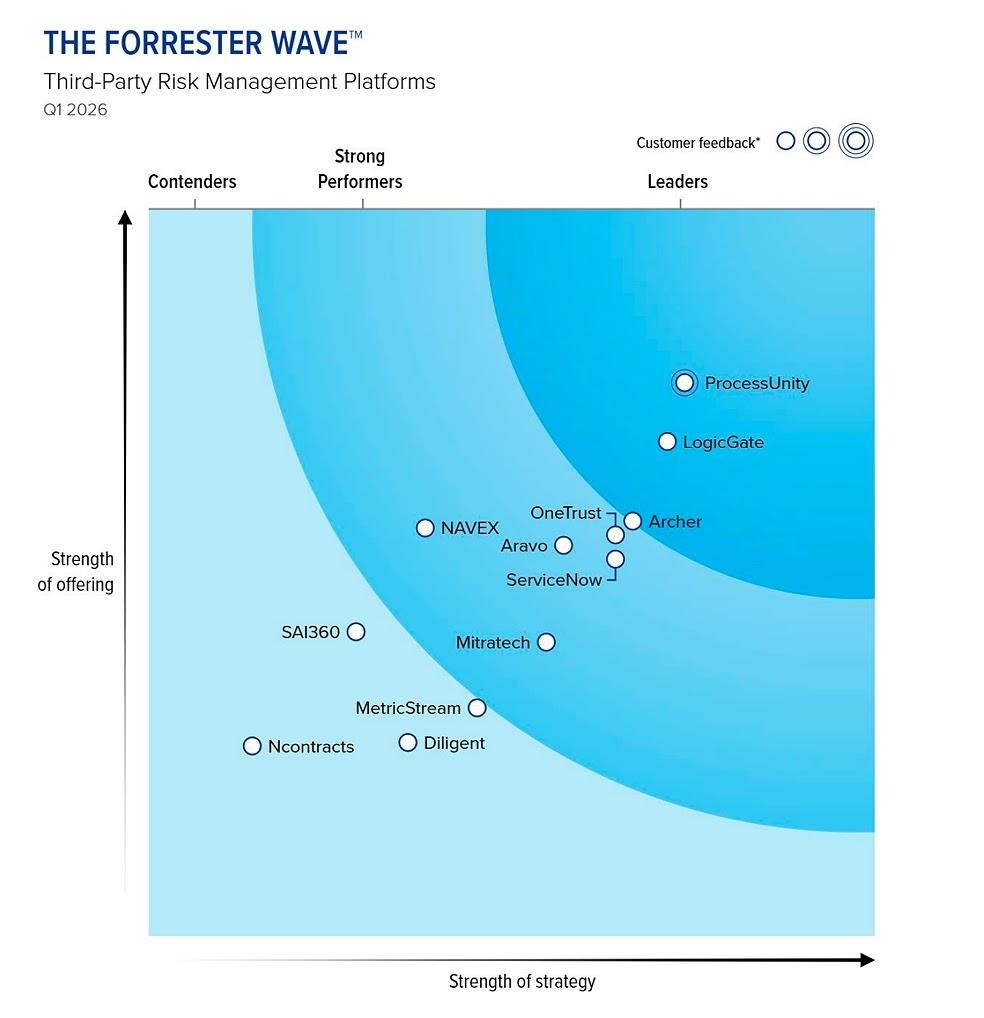
Next, we pressure-tested that list against analyst and customer reality. We read the Forrester Wave™: Third-Party Risk Management Platforms, Q1 2026, which scores vendors on 27 criteria and names ProcessUnity, LogicGate, and Archer as leaders. We also pulled themes from Gartner Peer Insights and G2 reviews, focusing on what buyers learn the hard way, such as onboarding time, support quality, and hidden costs that do not show up in product pages.
Then we validated the claims in the product. We asked each shortlisted vendor for a live walkthrough or sandbox login and tested specific promises, such as “AI autofills 80 percent of a SIG Lite in one click” or “continuous monitoring pings every hour.” When the marketing story did not match what the product actually did, scores dropped.
Finally, we scored each platform against the seven criteria in the next section. AI depth carried the most weight, and price transparency the least. No vendor paid to be included, and every tool was measured with the same scorecard. The goal is simple: apples-to-apples clarity, not pay-to-play promotion.
This approach combines search reality, analyst rigor, user sentiment, and hands-on validation. You can replicate it, but we have done the legwork to make your shortlist faster and more defensible.
What “best” really means: the seven-factor scorecard
“Best” only matters if you can explain what you’re optimizing for. We scored every platform against seven criteria that map to how SaaS security and GRC teams actually run vendor risk day to day.
AI capability carried the most weight because it is the biggest force multiplier for lean teams. Continuous monitoring came next, because an annual questionnaire is outdated the moment a zero-day hits. After that, we looked at how well each platform fits into a modern SaaS stack, how clearly it maps work to common compliance needs, and whether it can scale without collapsing into admin overhead.
Here are the weights we used:
- Scalability – 10 percent
- User experience – 10 percent
- Pricing transparency – 5 percent
- Compliance alignment – 15 percent
- Continuous monitoring – 20 percent
- SaaS-stack integrations – 15 percent
- AI automation & intelligence – 25 percent
The weights add up to 100, by design. A platform that is excellent at AI and monitoring can rank highly even if it is average on pricing transparency. That reflects the reality for most SaaS teams. Time and visibility usually matter more than a perfectly clean pricing page.
Two criteria deserve extra context:
- AI automation: Vendors routinely send 60-page SOC 2 reports and expect a decision quickly. We favored tools that can summarize, highlight gaps, and flag contradictions fast, so your team spends time on risk decisions instead of PDF searches.
- Monitoring: We scored “always-on” approaches higher than weekly refreshes. The best platforms surface meaningful changes quickly and route them into workflows your team already uses.
Integrations, scalability, and UX were the tie-breakers. A platform that connects to tools like Okta, Coupa, and Jira reduces manual work and helps you spot new vendors sooner. And if analysts avoid the interface, even strong automation will go unused.
With the scoring model set, the rankings below reflect what performed best against that rubric.
1. Vanta: turning vendor risk into a routine chore, not a fire drill
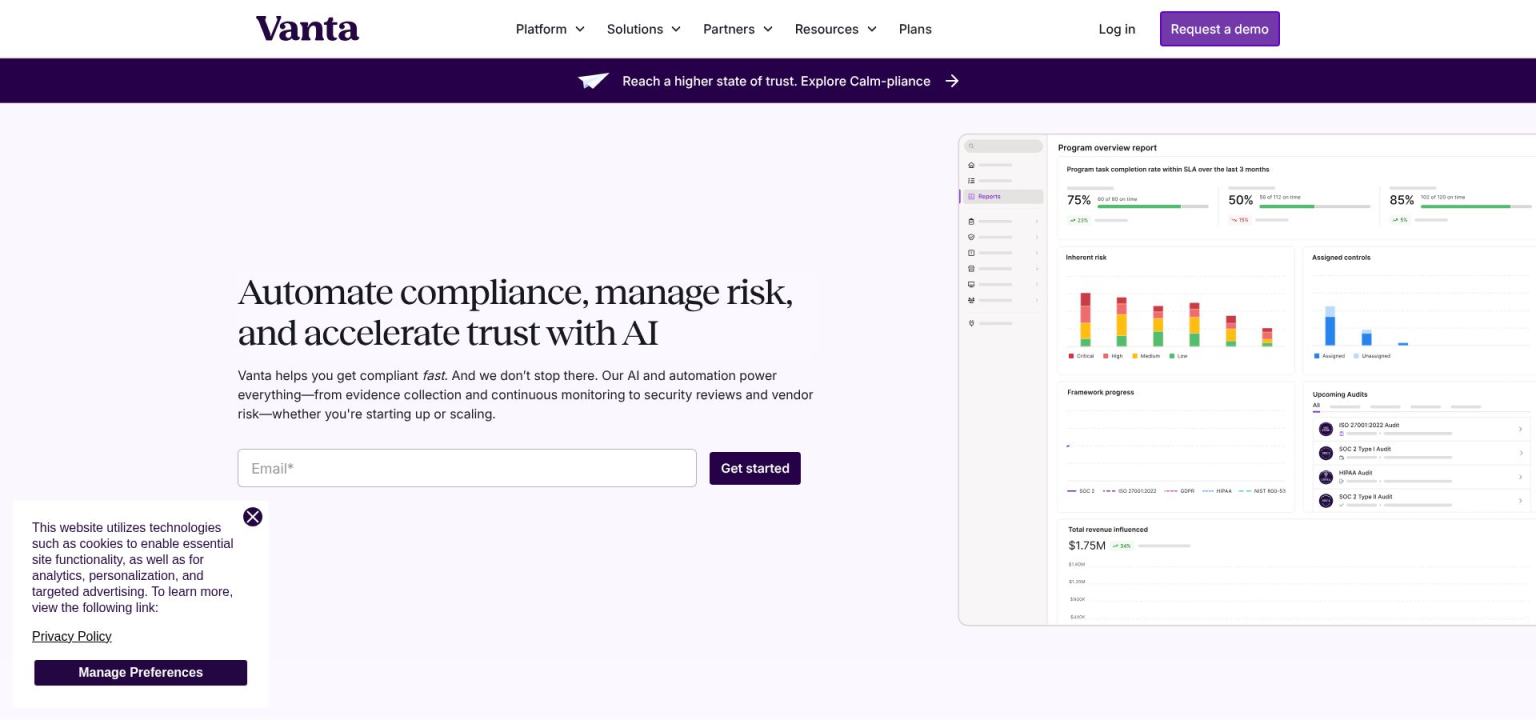
Vanta’s risk management platform ranks first because it handles vendor oversight in the same place you already manage your own compliance evidence. For SaaS teams that live in audit cycles and customer security reviews, that matters. You are not adding another dashboard; you are extending an existing trust workflow to cover the third parties your product depends on.
Core capabilities
Vanta combines compliance automation with a vendor-risk module, so evidence, alerts, and control mappings sit in one system. If you already use Vanta for SOC 2 or ISO work, vendor reviews plug into the same program instead of becoming a parallel spreadsheet process.
AI features
Vanta’s document-reading AI is the workhorse. Upload a SOC 2 report, and it produces a concise summary of control gaps, encryption quirks, and remediation suggestions. It also reviews questionnaire responses, highlights contradictions, and flags answers that fall outside your risk appetite. Customers report review time dropping by about half, which is often the difference between “we assessed the vendor” and “we assessed the vendor and followed up.”
Continuous monitoring
Monitoring runs in the background and focuses on issues teams can act on quickly. Vanta watches for leaked credentials, misconfigured S3 buckets, expiring certificates, and breach-feed signals. When something crosses a threshold, it can open a Jira ticket with enough context for an engineer to triage without a back-and-forth thread.
Assessment workflow and day-to-day operations
The workflow is designed to keep reviews moving. Instead of forcing analysts into PDF spelunking, the platform pushes them toward decisions, follow-ups, and remediation tracking. The result is less time formatting evidence and more time closing gaps with vendors.
Integration ecosystem
Integrations are a major reason Vanta works well in fast-moving SaaS environments. Connect tools like Okta, Coupa, and Vanta, and Vanta can surface new SaaS purchases as they appear, which helps keep your vendor inventory current. Tie in Slack and Jira and risk updates land where work already happens, not in yet another inbox.
Vendor lifecycle coverage
Vanta supports ongoing oversight through monitoring and workflow-driven follow-ups. It is built to keep the “vendor file” alive over time instead of treating risk as a one-time intake task.
Best fit
Vanta is ideal for:
- Mid-market SaaS companies managing roughly 50 to 500 vendors
- Small security and GRC teams that need automation and a straightforward interface
- Teams that want vendor risk and audit readiness to share the same evidence and control mappings
Key limitations
Vanta is not perfect for every program. It relies on partner feeds for deeper outside-in scanning, so some teams still pair it with a dedicated ratings platform for extra assurance. Very large enterprises with complex org charts may also find hierarchy features still maturing.
Pricing signal
Vanta is often positioned as a SaaS-first option. Entry packages are commonly described as starting in the low five figures, depending on scope and modules.
Differentiator
Vanta’s differentiator is the integration of two jobs that usually live apart, proving your own posture to customers and continuously assessing the vendors behind your stack. For lean teams, that shared system of record is often what turns vendor risk from a fire drill into a repeatable program.
2. OneTrust: the privacy powerhouse built for complex enterprises
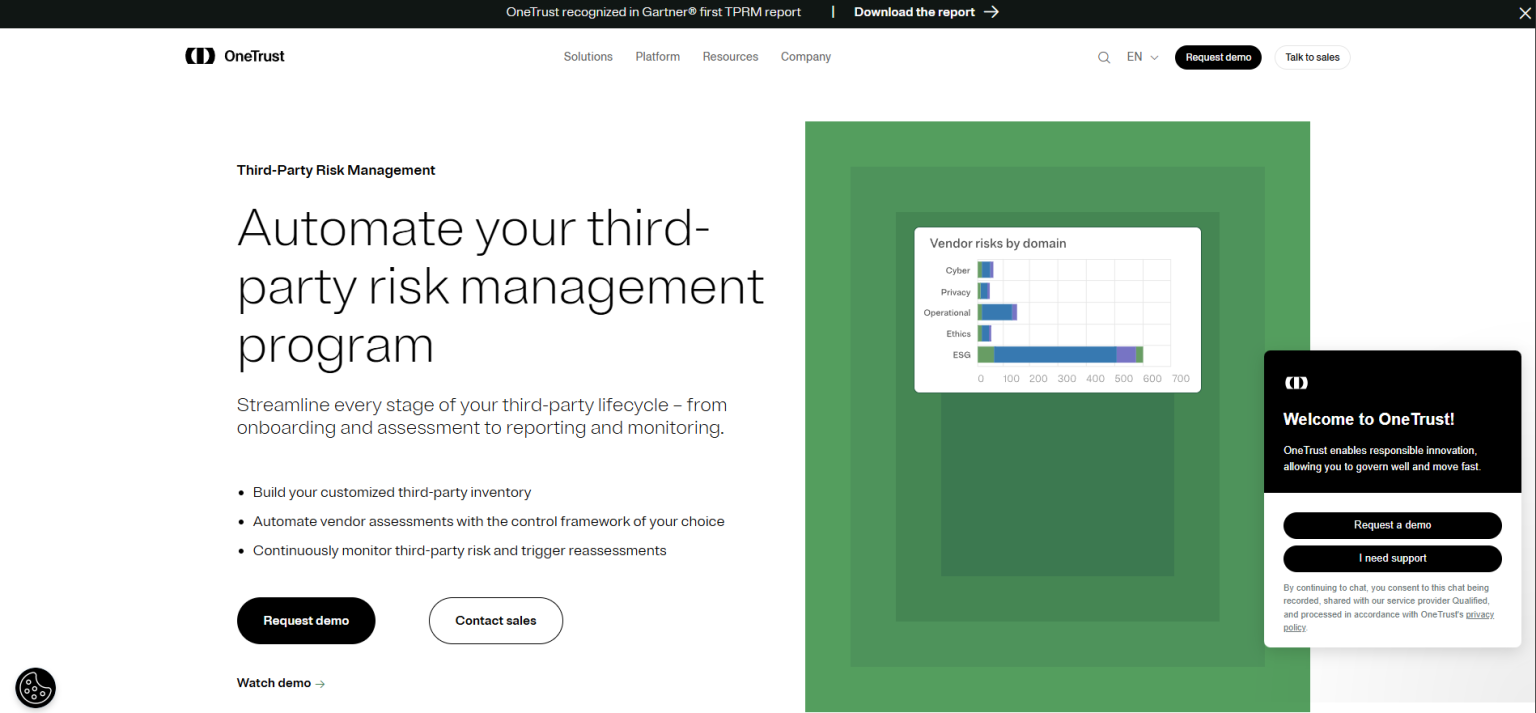
OneTrust is strongest when vendor risk is inseparable from privacy, legal review, and data governance. If your SaaS handles large volumes of customer data and lives under GDPR scrutiny, OneTrust can function as a shared workspace for Security, Legal, and Procurement instead of another silo.
Core capabilities
OneTrust grew up in privacy management, and its third-party risk module reflects that. It comes preloaded with Data Processing Agreements (DPAs), cross-border transfer checks, and Data Protection Impact Assessment (DPIA) workflows. That foundation makes it easier to run vendor reviews that account for both security posture and privacy obligations.
AI features
Automation is present, but conservative. OneTrust offers an early-access Third-Party Risk Agent that reads assessment answers and flags gaps. Overall, the platform still leans more on rules, templates, and structured workflows than on deep LLM-style summarization.
Continuous monitoring
Continuous monitoring is driven through partner feeds such as SecurityScorecard. That means outside-in visibility depends on the integrations you enable. OneTrust works well as an aggregator of signals, not as a scanner in its own right.
Assessment workflow
OneTrust is built for organizations where vendor reviews span multiple business units, regions, and approval chains. You can create nested hierarchies that mirror your org chart, map each engagement to specific data types, and route approvals through InfoSec, Legal, and Procurement in parallel. The visual workflow editor is powerful, but it can feel intimidating at first. Many teams rely on OneTrust professional services to configure it.
Integration ecosystem
Reporting and analytics are a practical strength. Out-of-the-box Power BI dashboards let you slice risk by regulation, geography, and vendor criticality. For example, you can quickly show which suppliers lack a GDPR Article 28 clause, or pull a heat map of high-risk vendors that touch production data.
Vendor lifecycle coverage
OneTrust supports end-to-end governance across stakeholders, with particularly strong coverage where privacy assessments, contract terms, and vendor access to personal data are central to the decision.
Best fit
OneTrust is ideal for:
- Large enterprises with multi-team, multi-region vendor review requirements
- SaaS companies where privacy and data governance drive the vendor-risk program
- Teams that need structured approvals and executive-ready reporting more than flashy AI
Key limitations
Trade-offs are real. Pricing starts high and often increases quickly as you add modules or scale vendor volume. Six-figure annual spends are common. Implementation can stretch for months without an internal champion who speaks both security and privacy. Smaller SaaS firms may find it more platform than they need, especially if the program is closer to 50 vendors than 5,000.
Pricing signal
Enterprise pricing is common, and costs tend to scale with modules and vendor volume. Expect a meaningful implementation effort as part of the total cost.
Differentiator
OneTrust’s differentiator is privacy-native third-party risk management. If your vendor program lives and dies by DPAs, cross-border transfers, and DPIAs, OneTrust already speaks the language your regulators and legal team expect.
3. Prevalent (Mitratech): lifecycle coverage from day-one questionnaire to offboarding
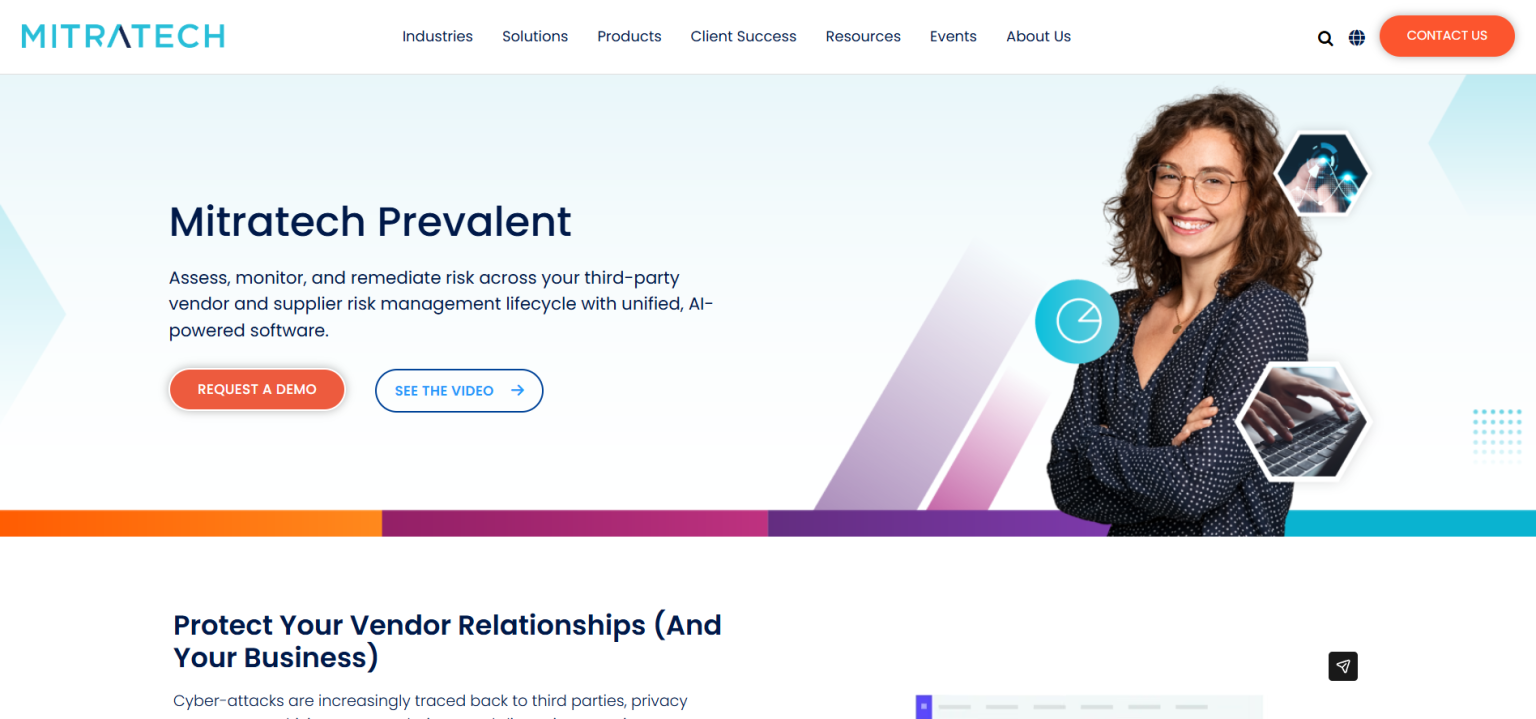
Prevalent, now backed by Mitratech, is built for teams that want one system to run the vendor lifecycle end to end. Instead of treating vendor risk as a one-time assessment, it keeps a single record that spans intake, due diligence, remediation, renewal, and offboarding.
Core capabilities
Prevalent aims to cover the full workflow. You start with an intake that calculates inherent risk, the platform automatically triggers the right questionnaire, and then you track remediation tasks and periodic reviews through renewal. When a contract ends, the offboarding checklist is part of the same trail, so ownership does not disappear when teams change.
AI features
Prevalent uses machine-learning models to watch how cyber, financial, sanctions, and negative news factors change over time. The practical value is early warning. Instead of only seeing a vendor’s snapshot score, you get alerts when their risk trajectory starts to trend in the wrong direction.
Continuous monitoring
Monitoring pulls together multiple categories of signals. The platform ingests cyber signals, financial health scores, sanction lists, and negative news from more than 500,000 sources, then rolls them into a single risk rating. It is designed to refresh continuously, so your program does not rely on last quarter’s questionnaire when the vendor’s posture has shifted.
Assessment workflow
Prevalent’s differentiator is the Prevalent Exchange, a library of thousands of pre-completed assessments and evidence packs for widely used vendors like AWS and Stripe, plus many niche SaaS providers. When there is a match, you can reuse existing evidence instead of sending another full assessment. That shortens cycles from weeks to hours in the best cases, and it reduces vendor fatigue on the other side of the email thread.
Integration ecosystem
Mitratech ownership adds connectivity if you already run parts of your GRC program there. Vendor findings can sync into broader risk registers and business continuity plans, and the integrated view is positioned to grow as the combined roadmap develops.
Vendor lifecycle coverage
Prevalent is designed for maturity and scale. It supports multi-stakeholder work through role-based dashboards, and it includes bulk actions that let you update hundreds of vendors at once. The emphasis is on operational control across a large, evolving vendor portfolio.
Best fit
Prevalent is ideal for:
- Compliance-heavy SaaS companies with hundreds of vendors
- Regulated teams that need one place to manage intake, assessment, monitoring, and offboarding
- Programs that can invest in process and ownership, not just a tool
Key limitations
The trade-off is complexity. Onboarding often requires dedicated admin time or partner help, and pricing typically lands in enterprise territory. Smaller SaaS teams may find lighter platforms easier to stand up and maintain.
Pricing signal
Enterprise-level pricing is common, and total cost is influenced by setup and ongoing administration.
Differentiator
Prevalent’s clearest advantage is evidence reuse through the Exchange, paired with a true lifecycle record that follows the vendor from initial intake through termination. For large programs that are tired of stitching tools together, that “one system of record” approach is the point.
4. SecurityScorecard: continuous letter grades for rapid triage
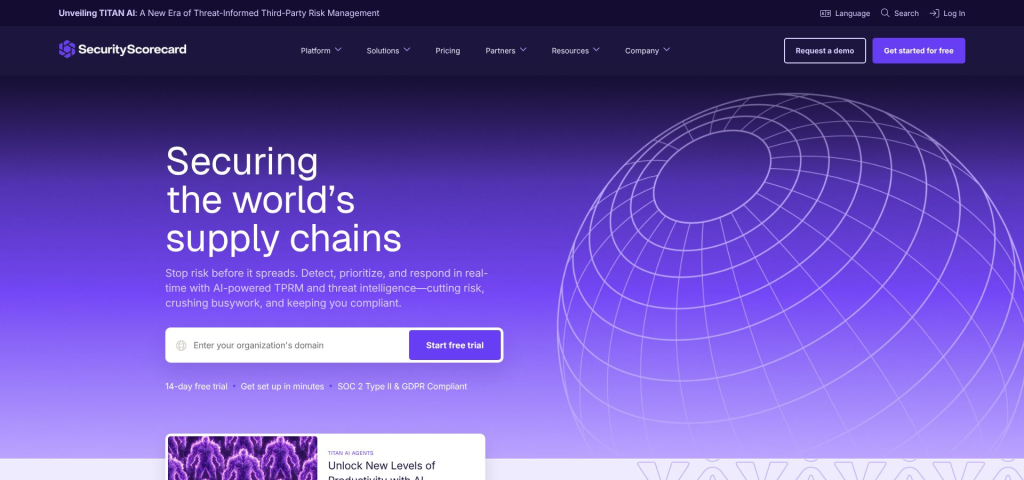
SecurityScorecard is the reference point for outside-in vendor monitoring. It popularized the idea of giving every company an easy-to-read security grade, and in 2026, it remains strongest when your main need is fast, continuous visibility across a large vendor set.
Core capabilities
At its core, SecurityScorecard assigns A-through-F grades based on what it can observe from the outside. Its scanners sweep the web each day and evaluate signals like open ports, botnet traffic, and leaked credentials. Those findings roll up into a score executives understand immediately.
That simplicity is the product. A “C” is easier to brief than a 47-page vulnerability report, and it gives busy teams a quick way to sort vendors and focus attention where risk is trending in the wrong direction.
AI features
SecurityScorecard uses AI models to translate over one hundred billion signals into its scoring system. It has also begun pushing into assessment workflows. The platform recently added questionnaire automation, including an AI feature called Smart Answers that can pre-fill common responses. It is early, but it signals a move beyond pure scanning.
Continuous monitoring
This is where SecurityScorecard stands out. It provides 24×7 outside-in monitoring through daily scanning and ongoing updates, which makes it useful for catching drift between annual reviews.
Assessment workflow
SecurityScorecard is also built to reduce friction with vendors. You can invite a supplier to claim its scorecard for free, review the underlying issues affecting the grade, and track fixes inside the platform. Many vendors treat the grade like a public-facing rating they want to improve, which can turn remediation from an email chase into a shared, visible workflow.
Integration ecosystem
SecurityScorecard can plug into common security workflows through APIs and integrations, and it is often paired with tools like Jira and SIEM platforms to route issues to the right place.
Vendor lifecycle coverage
SecurityScorecard is monitoring-first. It is strong at top-of-funnel triage and ongoing visibility, but it is not designed to run a full third-party risk management lifecycle on its own.
Best fit
SecurityScorecard is ideal for:
- SaaS teams with hundreds of vendors that need broad, always-on coverage
- Programs that want an executive-friendly metric for reporting and prioritization
- Teams that already have a separate workflow system for questionnaires, evidence, and remediation tracking
Key limitations
The grades can be a black box. You cannot tweak weightings or ignore a noisy subdomain without filing a dispute ticket. And while questionnaires exist, the platform does not offer the full lifecycle workflows found in broader TPRM suites. Many organizations pair it with platforms like Vanta or OneTrust to cover evidence collection and close-the-loop remediation.
Pricing signal
Expect enterprise pricing, and quotes typically scale with vendor count.
Differentiator
SecurityScorecard’s differentiator is breadth and speed. If you want a real-time barometer across every vendor and a simple grading system that leadership understands, it is the industry yardstick. It works best when you connect that visibility to a process that drives follow-up and remediation.
Feature snapshot: compare the platforms side by side
If you read the reviews and thought, “I just need the differences,” this is the shortcut. The matrix below summarizes what each platform is best known for, how it monitors vendors, and whether it offers an evidence network you can reuse.
| Platform | Stand-out AI skill | Monitoring cadence | Integration depth | Evidence exchange | Ideal team size |
| Vanta | NLP summaries of SOC 2 and questionnaires | Hourly internal signals plus partner breach feeds | 375+ SaaS connectors | No | Mid-market (50–500 vendors) |
| OneTrust | Rule-based privacy mapping; AI agent in preview | External ratings via partners (daily) | Broad GRC stack; Power BI | Limited | Large enterprise |
| Prevalent | Predictive residual risk scores | Daily cyber, financial, news | Tight with Mitratech suite | Yes (Prevalent Exchange) | Enterprise, regulated |
| SecurityScorecard | ML on 100B+ external signals for A–F grade | 24×7 outside-in scanning | API; Jira; SIEM | Marketplace for vendor access | Any size needing breadth |
Use the table to validate a shortlist, not to pick a winner in isolation. Your best match still comes down to your primary bottleneck, automation depth, monitoring strength, privacy nuance, or vendor collaboration.
Quick FAQs that clear lingering doubts
We’re a 20-person SaaS startup. Do we need a third-party risk management (TPRM) tool yet?
If you handle customer data and plan to sell to enterprises, yes. Start lightweight. A TPRM vendor shows prospects you take vendor risk seriously and keeps you from rebuilding spreadsheets every quarter.
How does AI actually cut the workload?
Mainly in two ways:
- Document intelligence: Highlights gaps in 100-page SOC reports so you spend minutes, not hours, on first-pass review.
- Auto-fill: Pre-populates up to 80 percent of vendor questionnaires so reviewers focus on exceptions, not repetitive answers.
Teams commonly report 40 to 50 percent time savings once these features are part of the workflow.
Can I rely on ratings alone?
Ratings give 24×7 breadth, but they miss policy controls and contract terms. Pair a ratings feed like SecurityScorecard with an assessment workflow tool like Vanta or OneTrust to get both the outside-in and inside-out view.
What should I show the board?
Pick a metric leaders can track over time. Many teams use the percentage of critical vendors at grade A or B. Tie the metric to incident trends or dollars at risk so directors can see movement, not just a snapshot.
Implementation: weeks or months?
SaaS-first TPRM platforms can go live in days because they lean on API connectors. Enterprise suites with custom workflows often need a real project plan and can stretch to three months. Budget calendar time alongside dollars.
Conclusion
Still stuck? Book demos with your top two candidates and run one real vendor through the full cycle intake, evidence, follow-ups, and reporting. The gaps show up fast.
(Photo by John on Unsplash)


