




Press play to start listening
AI Voice Cloning meant having a voice model trained for hours, acquiring extremely high-quality recordings in a studio, and deploying a team of high-level researchers. Now, even some DIY tools can replicate a human voice from a short recording segment in a matter of minutes, producing results that are close to authentic oral speech. What was previously a feature only available to Hollywood production houses and intelligence-grade systems is now doable from a simple web browser.
This has caused voice cloning to become one of the fastest-growing segments of generative AI. Here, we will analyze the basics of technology, the players in the ecosystem, the sectors that have already embraced it, and where the technology may be heading. Let’s explore further!
What Voice Cloning Actually Is (And What It Isn’t)
Voice cloning is using AI to create a synthetic version of a particular person’s voice, enabling one to produce new speech either from a text or audio input.
It would also be helpful to distinguish voice cloning from some nearby technologies, which are often mixed up with it:
- Text-to-speech (TTS): Produces speech directly from text using either standard or specially made voices.
- Voice conversion: Alters the voice of one speaker into that of another in real time.
- Voice cloning: Constructs a digitally reusable voice of a particular person that can also generate completely new speech.
Different existing systems vary considerably in the method they use to train and generate cloned voices. The main approaches are:
- Zero-shot cloning: Copies a voice from just a few seconds of audio without any additional fine-tuning.
- Few-shot cloning: Utilizes a few-minute-long recordings to enhance realism and stability.
- Full fine-tuning: Deeply trains on hours of audio to create highly precise, professional-grade voice models.
The Technology Stack: How Voice Cloning Actually Works
The Data Layer
Every voice cloning system initially grabs data. At the heart, voice model development is done via voice recordings plus text transcripts and metadata, which assist the system in understanding how words, pronunciation, timing, and vocal traits are interrelated.
The amount of data required is drastically different based on what type of cloning system is employed:
- Zero-shot cloning: Typically needs just 3 to 10 seconds of speech.
- Few-shot cloning: Generally, it operates with 1 – 5 minutes of recordings.
- Full fine-tuning: Might take 1 hour or even more of top-notch voice data for the highest level of realism and consistency.
The Model Architecture Layer
Currently, state-of-the-art voice cloning systems integrate multiple independent AI architectures, where each is responsible for a different layer in speech generation and realism.
- Encoder-decoder models: The encoder converts a person’s unique voice into an embedding of a speaker, which is a numerical representation, and the decoder produces speech based on that voice profile.
- Diffusion models: They are progressively being adopted to generate top-quality speech. These models, by gradually cleaning the noisy signals, produce speech that is very close to the real one.
- Transformer-based TTS: Using attention mechanisms, these models time, rhythm, and long-range speech dependencies, resulting in hearing conversational flow as opposed to the first sequence-to-sequence systems.
- Neural vocoders (WaveNet, HiFi-GAN): This layer is responsible for turning model predictions into real audio waveforms. Vocoders greatly influence clarity, realism, smoothness, and overall listening quality.
The speaker embedding
Speaker embedding is a short, high-dimensional vector that describes a person’s voice in unique ways. Using that, a voice model can tell the difference between the content (words) and the speaker (the voice), which is the most important factor when you want to create a totally convincing voice clone.
Training vs. inference
Training is the stage when the voice model is built or adjusted. It is very demanding in terms of computing resources, and, usually, the training of a voice model happens only once for each voice.
Who’s Building It: The Voice Cloning Ecosystem
Foundation Model Labs
Research centers and AI teams produce the fundamental speech models on which the entire AI speech ecosystem is based. Open-source projects such as Coqui TTS, Tortoise TTS, and Bark have significantly reduced the work needed by developers, thus speeding up the commercial usage just like the openly available LLMs did for AI text.
Enterprise / B2B Platforms
Such firms concentrate on the uses of voice tech in various businesses like interactive voice response (IVR) systems in voice banking, dubbing in different languages, and accessibility.
Consumer-Facing Platforms
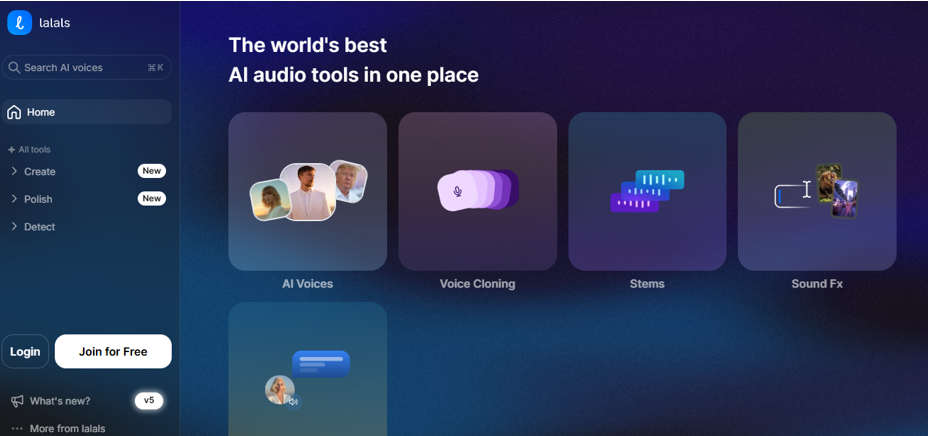
This is the point at which most noticeable innovation takes place. For example, according to platforms like Lalals, merging voice cloning, live voice changing, text-to-speech, and sound editing features into a single environment for artists and content creators should be considered core elements of the category.
Embedded / API-First Players
The voice cloning capability of these platforms is an infrastructure resource for software development. Voice cloning technology is being progressively integrated into applications, games, podcasts, and accessibility tools via APIs.
Hardware-Adjacent Development
By executing models locally, latency can be minimized, privacy can be enhanced, and cost can be reduced, all of which are critical for scenarios like live communication and offline applications.
Real-World Use Cases Gaining the Most Traction
| Category | Use |
| Music & creative production | AI vocals, covers, music experimentation |
| Content & media | Voiceovers, podcasts, dubbing, YouTube videos |
| Accessibility | Voice restoration for speech-impaired users |
| Enterprise | Customer support, IVR, branded voices |
| Developers & research | APIs for apps, games, and audio AI tools |
The State of Output Quality in 2026
These days, voice cloning at its best can be hard to tell apart from an actual human voice, at least in normal listening scenarios. Still, there are missing pieces when it comes to the seamlessness of long pieces, the delivery of extremely emotional pieces, very unusual accents, and the switching of languages.
Generally, quality is assessed along four dimensions: naturalness, speaker similarity, intelligibility, and prosody (rhythm and intonation). As for the major evaluation technique, it is MOS (Mean Opinion Score), yet it is recognized as subjective and quite restrictive.
Note: Voice cloning comes with the same kind of security risks as earlier voice recognition technologies. As stated in voice-based security studies, it turns out that even very simple recorded or synthetic voice inputs may be enough to fool the authentication systems that are not secure.
Where It’s Headed: The Next 3–5 Years
Zero-shot quality reaches parity
Zero-shot voice cloning with just a few seconds of audio will produce results indistinguishable from those of fine-tuned models, making voice synthesis of high quality extremely simple and available to nearly everyone.
Real-time everywhere
Latency will be eliminated to a degree that even humans will not be able to tell the difference in delay (<50ms). This will open a whole gamut of instant, real-time applications such as live interpretation or voice changing, and even supported communication.
Multilingual voice preservation
An individual voice will be capable of naturally speaking multiple languages without losing the unique characteristics that define it, such as identity, tone, and style of speaking.
Voice as personal infrastructure
Users will be the owners of voice models, which may be seen as digital assets and will be used across platforms for identification, content creation, and accessibility.
Integration into the broader AI stack
Voice cloning will be as ubiquitous as text, image, and video generation and will be just another standard layer inside multimodal AI systems rather than being a separate tool.
Conclusion
Voice cloning has progressed from being an experimental technology to a real, in-demand feature in media, music, accessibility, and business. Since ultra-human-like imitation is now the standard, the first pulse of the movement is on the areas of control, safety, and performance in real-time.
As the scene changes and grows, platforms are streamlining AI voice technology and presenting it in one place for creators and developers by combining voice cloning, conversion, and audio tools. Voice cloning is no longer limited to imitating sound; it is becoming a foundation for modern digital communication and content creation.