




Press play to start listening
If you are specifying an identity system this year, the choice between iris and fingerprint is no longer a simple one. Both modalities are mature, both are independently tested by NIST, and both now run fast enough for real-time use at the edge.
The honest answer to “which wins” depends on the environment, the threat model, and how much friction your users will tolerate. Modern iris authentication has closed much of the speed gap that once made it impractical, and platforms such as ROC AI iris recognition now return a match in a fraction of a second, which reframes the whole comparison.
Start with how each modality actually works, because that explains most of the trade-offs. A fingerprint system reads the friction-ridge pattern on a fingertip, extracts the minutiae (ridge endings and bifurcations), and converts them into a template it can search.
Iris detection captures the complex texture of the colored ring around the pupil, a pattern that is set early in life and differs even between identical twins and between a person’s own left and right eyes. Fingerprints have a century of forensic precedent and an enormous installed base; iris has the advantage of being contactless and extremely stable over a lifetime.
Speed and accuracy are where a careful biometric comparison gets interesting. Fingerprint matching is the workhorse of large-scale identification, and a high-end fingerprint matcher is built for forensic-grade 1:1 verification and 1:N search across databases of any size.
Iris, meanwhile, has historically been accurate but slow. That has changed: in the NIST IREX 10 evaluation, ROC reports its iris algorithm running roughly 180 times faster than the industry standard while holding 99.3 percent accuracy at a false-positive identification rate of one percent. When a modality that was already precise also becomes near-instant, it stops being a niche choice.
How the two modalities compare
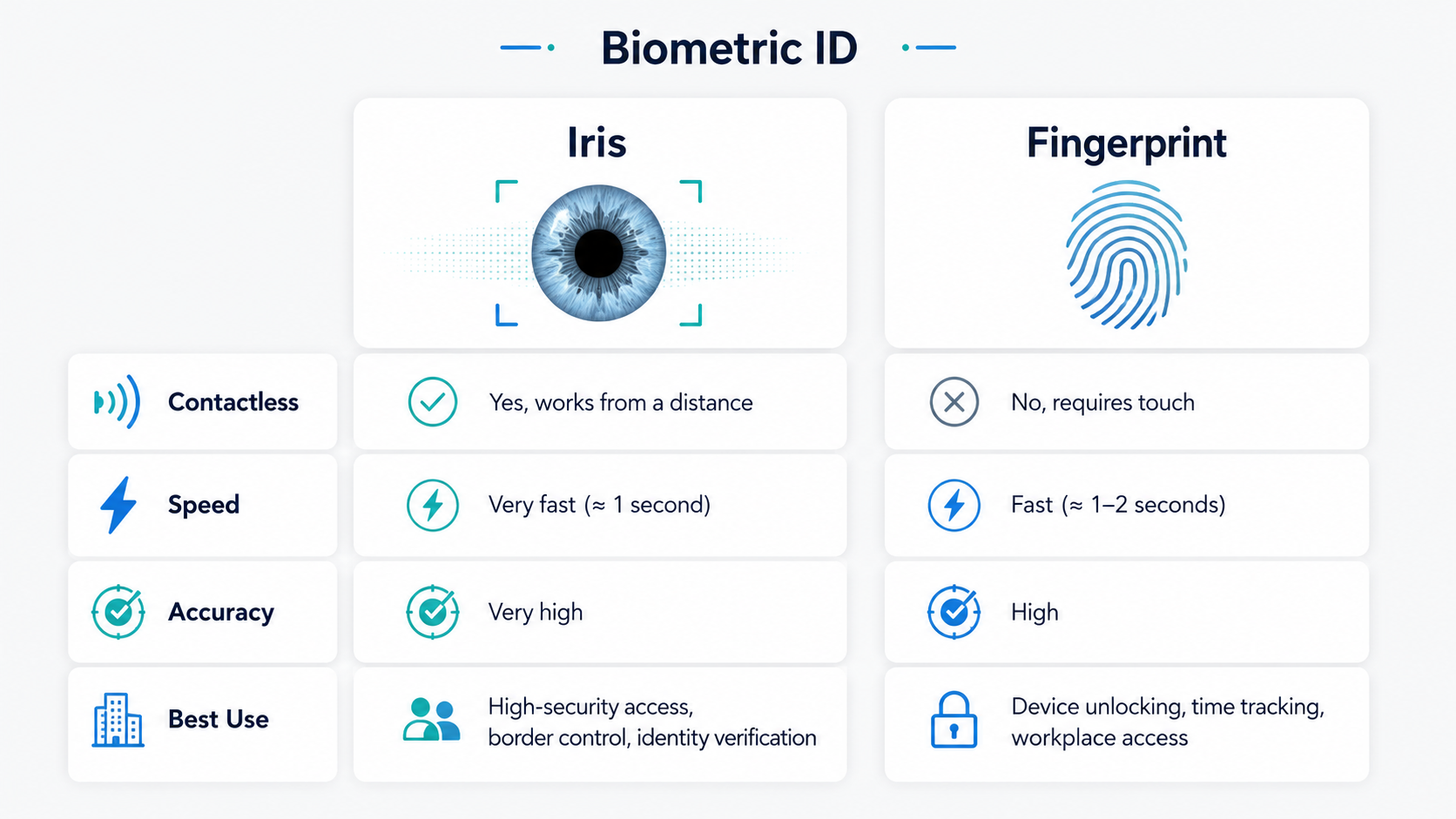
The clearest way to choose is to line up the attributes that matter operationally rather than arguing about which is “best” in the abstract.
| Attribute | Fingerprint | Iris |
| Contact | Usually contact-based (contactless capture is emerging) | Fully contactless |
| Permanence | Stable, but prints wear with manual labor and age | Very stable across a lifetime |
| Forensic precedent | Extensive (latent prints, court acceptance) | Limited forensic history |
| Speed at scale | Very fast with modern matchers | Now near-instant with current algorithms |
| Best-fit settings | Booking, background checks, access control, field ID | High-security access, border control, banking |
| User friction | Low, familiar | Low, no touch required |
No single row decides the question. A booking station or a latent-print investigation leans fingerprint because of forensic precedent and the volume of existing records. A hygienic, high-throughput checkpoint leans iris because contactless biometric authentication keeps lines moving without anyone touching a shared sensor.
Where contactless capture changes the math
The pandemic permanently raised expectations around touchless systems, and that shift favors iris in shared environments. Airports, hospitals, and secure facilities increasingly want identity checks that do not require physical contact with a scanner. Iris delivers that natively, which is why it shows up in border control and visitor-management deployments where speed and hygiene both matter.
Fingerprint vendors have responded with contactless options of their own, including capture from a short distance, so the gap is narrowing. The practical takeaway is that “contactless” is no longer a reason to rule fingerprint out, but iris still has the cleaner story when zero contact is a hard requirement.
Spoofing, privacy, and responsible deployment
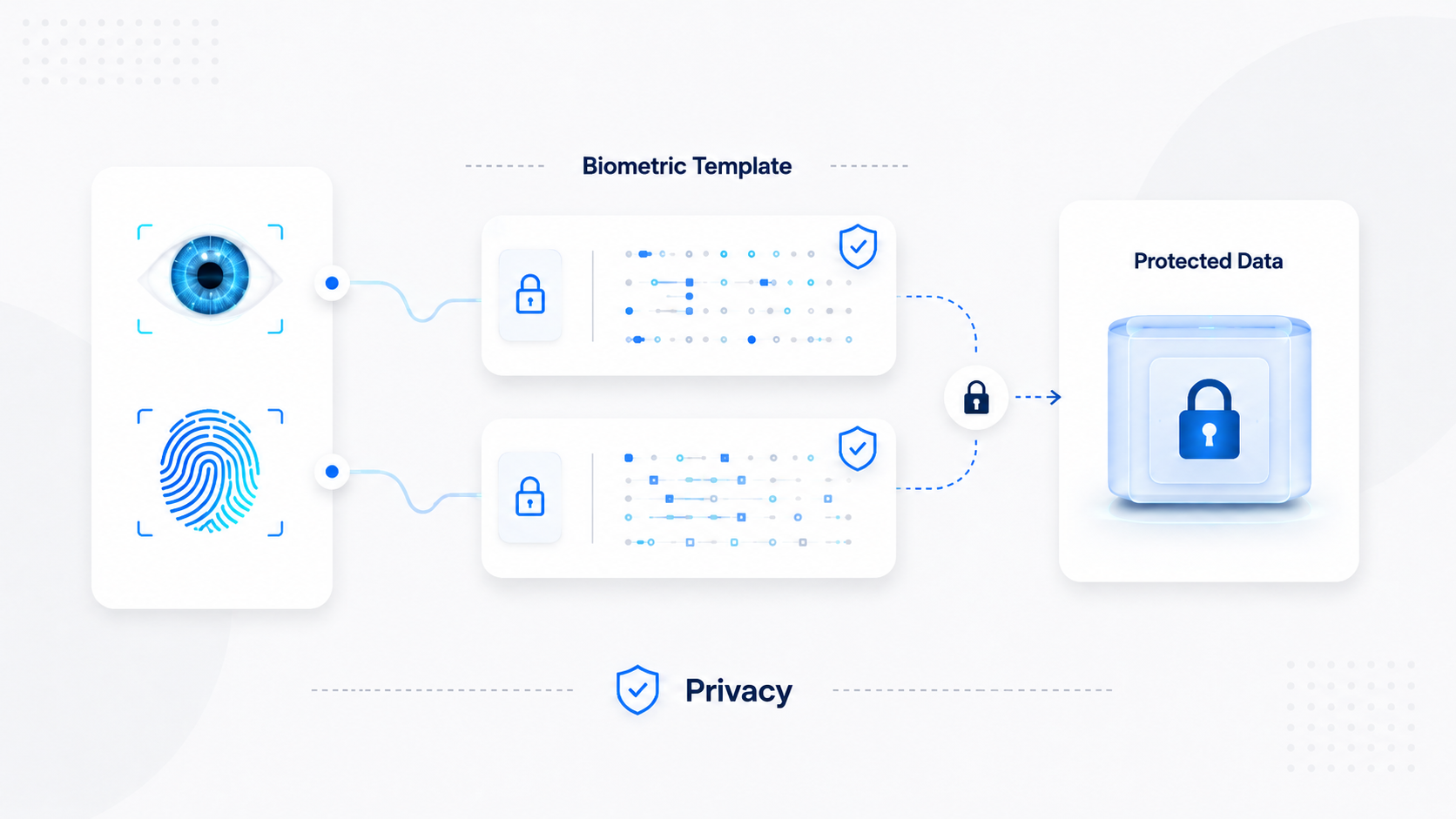
Any honest comparison has to address attacks and oversight, not just accuracy. Both modalities can be targeted by presentation attacks, and both are strongest when paired with liveness detection that confirms a real, present person rather than a photo, replica, or recording. Template protection matters too: well-designed systems store a mathematical template rather than a raw image, which reduces the privacy exposure if a database is ever breached.
Responsible deployment is the part buyers should weigh as heavily as benchmarks. Biometric accuracy varies with capture conditions, demographic performance must be measured rather than assumed, and any identification system should run under clear policy, consent where appropriate, and auditable human oversight. Independent NIST testing and published performance across demographic cohorts are the signals worth asking any vendor to produce.
So which one wins?
For most organizations, the framing of “iris versus fingerprint” is the wrong question. The more useful question is which modality fits each touchpoint, and whether a multimodal approach gives you resilience when one signal is unavailable.
A field officer collecting evidence needs fingerprint. A bank onboarding a customer may prefer iris or face with liveness. A national ID program often enrolls several modalities so it can deduplicate reliably across a whole population. The systems that age best treat face, fingerprint, and iris as complementary inputs to one identity decision rather than competitors.
If there is a 2026 headline, it is that iris has earned a seat at the table for high-assurance use cases it was once too slow for, while fingerprint remains indispensable wherever forensic precedent and existing records dominate. Rank One Computing is one of the vendors publishing independent NIST results across all three modalities, which makes its testing data a useful reference point as you scope your own requirements.