





Press play to start listening
The global financial system operates on a single continuum. The narrative that cryptocurrency exists as an isolated and experimental market no longer matches current realities. Digital assets have established a permanent footprint in international markets, evidenced by a total crypto market capitalization reaching $2.66 trillion.
This scale materialized because the industry dismantled its early, fragmented architecture to replicate and improve upon the core infrastructure of traditional finance.
Market participants now interact with digital assets through established institutional frameworks rather than experimental rails. Large allocators view these tools not as novelties, but as necessary components for modern portfolio construction.
Unbundling Market Structure: Custody Meets Execution
For years, the primary structural barrier for large investors was the bundled nature of cryptocurrency exchanges. Early digital asset platforms forced participants to rely on a single entity acting simultaneously as broker, exchange, and custodian.
This model contradicted decades of established risk management practices in legacy markets. The industry adapted by unbundling these services to mirror familiar traditional finance workflows, operating much like established prime brokerage relationships.
Institutions require distinct separation between trade execution and asset storage. Catherine Chen, Head of VIP and Institutional at Binance, captures this shift during a recent interview, “Institutions care about regulatory compliance, regulation, and counterparty risk. They are used to a certain market structure that has operated for decades, where trading, custody, and clearing are separated, whereas in crypto, it’s all in one.”
Chen continued, “Generally speaking, institutions are used to settlement happening post-trade, without needing to move assets until the transaction is completed. In crypto, however, accounts typically need to be prefunded, meaning assets are often held on the exchange before the trade takes place.”
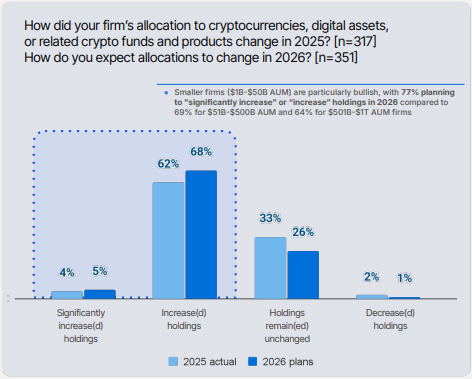
This separation of functions can influence how institutions approach capital deployment. EY-Parthenon’s survey data shows that 73% of institutional respondents plan to increase their digital asset allocations in 2026. This intended growth reflects confidence in institutional-grade infrastructure that satisfies strict internal governance requirements.
Legislative Clarity and the Stablecoin Settlement Layer
Regulatory frameworks have rapidly caught up to technological advancements and transformed the baseline for digital asset operations. The passage of the GENIUS Act in July 2025 established a comprehensive federal structure for stablecoins in the US market.
By mandating a 100% reserve requirement with liquid assets like short-term Treasuries and enforcing strict Bank Secrecy Act compliance, the legislation shifted stablecoins from a niche trading pair into a globally recognized settlement rail. It also requires public monthly disclosures of reserve compositions, offering the transparency that institutions demand. This regulatory foundation has driven the stablecoin market capitalization to $323.8 billion.
Asset managers and corporate treasuries now treat these instruments as fundamental operational tools. According to EY-Parthenon findings, 86% of institutional investors currently use or plan to use stablecoins. Their priorities reflect clear operational demands, with 88% focused on T+0 securities settlement and 85% leveraging them for internal cash management.
Clear rules regarding reserve composition and anti-money laundering controls allow these digital instruments to integrate smoothly into standard corporate treasury functions, bypassing the friction of legacy correspondent banking.
Activating Idle Capital with Tokenized Yield
The maturation of the stablecoin settlement layer directly supports a more efficient collateral environment. Capital efficiency remains a strict requirement for trading desks, and traditional finance relies heavily on yield-bearing assets to meet margin requirements.
The Grayscale 2026 Outlook indicates that tokenized assets have reached an inflection point, with decentralized finance pushing to a total market capitalization of $85.72 billion as lending and yield-generation migrate on-chain.
Institutions can now activate idle capital through programs that merge regulated custody with strong market depth. Binance VIP, in collaboration with Franklin Templeton and Ceffu, developed an off-exchange collateral model that allows eligible clients to pledge tokenized money market funds for trading. Instead of transferring cash directly to an exchange, institutions hold tokenized shares in regulated custody and use their value to collateralize positions.
This structure maintains continuous and round-the-clock market access while ensuring that underlying assets remain segregated and productive. It effectively eliminates the divide between legacy protections and modern asset utility.
The Blueprint for a Unified Financial Future
The convergence of regulated stablecoins and unbundled custody via tri-party banking arrangements, as well as tokenized collateral, indicates a fundamental maturation of the market. Digital assets now operate on infrastructure that satisfies strict regulatory demands while preserving the efficiency of blockchain technology. Investors utilize familiar legal structures and comprehensive compliance frameworks along with secure custody arrangements without sacrificing execution speed.
The integration of tokenized RWAs into active trading environments shows that the digital space can support large-scale activity with consistent liquidity. Market participants no longer need to choose between legacy protections and digital efficiency.
The infrastructure is fully integrated across both domains, serving institutional demands at scale. The structural gap between traditional finance and cryptocurrency has effectively vanished, and left behind a single and modernized financial ecosystem.
(Photo by Maxim Hopman on Unsplash)