





Press play to start listening
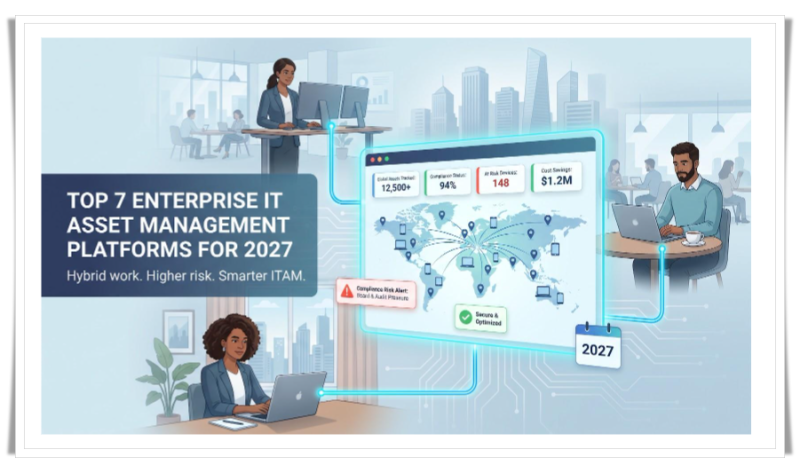
Missing laptops are no longer an IT headache; they’re a board-level risk. Last year alone, EU watchdogs issued €1.2 billion in GDPR fines, showing how quickly an untracked asset drains budgets.
Meanwhile, nearly half the workforce now toils from kitchen tables, cafés, and co-working hubs, turning every device into a roaming liability. We need smarter, harder-working IT asset management before 2027’s audits hit.
This guide ranks the seven platforms ready for that challenge and explains why each one made the cut.
How we picked the seven that matter
Before we crown any winners, you deserve to know how the sausage got made.
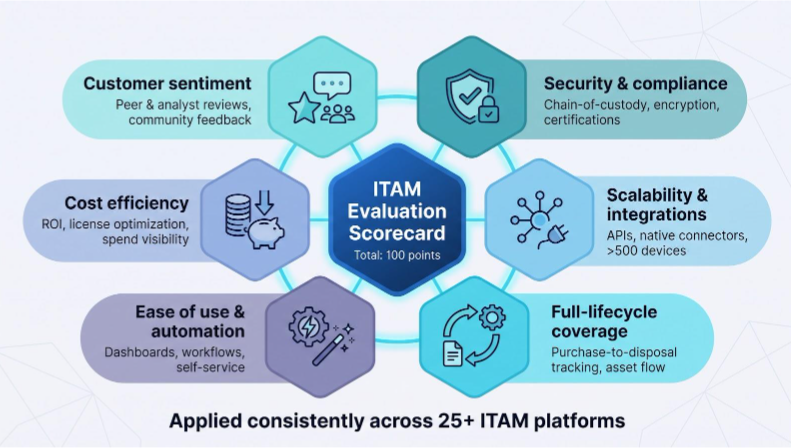
We began with a long list of twenty-five platforms pulled from Gartner, Forrester, and the r/sysadmin grapevine. Every name claimed “enterprise-grade” chops, but marketing slides are cheap, so we put each tool through the same six-factor scorecard.
First, security and compliance. If a platform cannot show chain-of-custody, encryption, or at least SOC 2 paperwork, it never left the bench.
Second, scalability and integrations. A modern IT estate spans Azure, Okta, Jamf, and a dozen surprise SaaS contracts. We looked for open APIs, native connectors, and customer references above five hundred devices.
Third, full-lifecycle coverage. Discovery is table stakes. We wanted purchase data in, disposal data out, and every refresh or retrieval tracked in between.
Ease of use and automation came next. Clean dashboards, zero-touch deployment, and AI that fixes bad asset data without an angry spreadsheet sprint.
Finally, cost efficiency and customer sentiment. We pored over public price ranges, analyst ROI calls, and the blunt honesty of Peer Insights reviews. A flashy feature that never pays for itself lost points fast.
Each factor carried a weight, summed to one hundred. The seven platforms you’ll meet next posted the highest composite scores, earning a place in this guide.
The 2027 ITAM environment keeps shifting under our feet
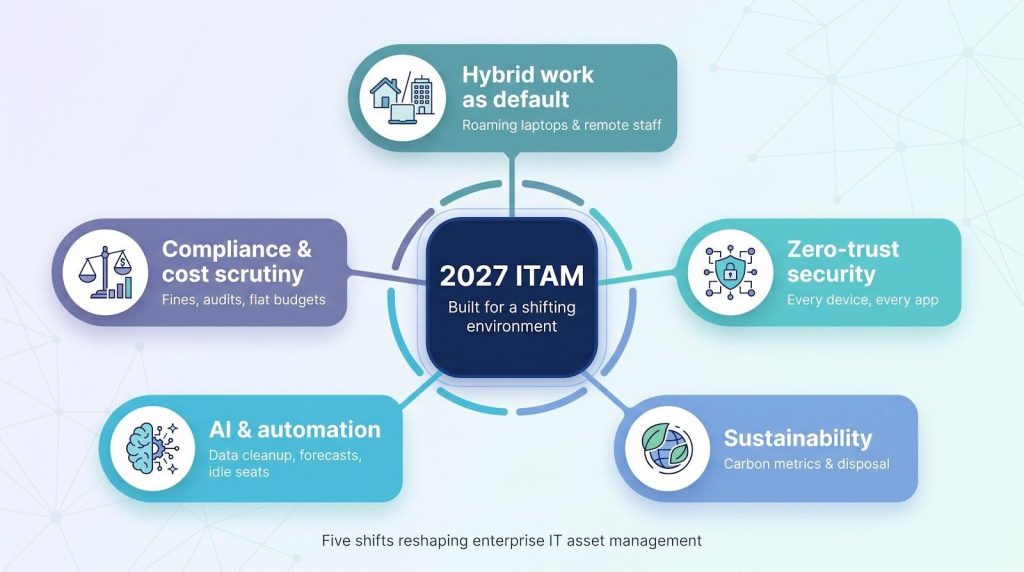
Hybrid work is no longer a pandemic hangover; it is the default. Surveys show roughly forty-four percent of UK staff now split their week between kitchen tables and office desks, and the US is tracking a similar arc.
That dispersion turns every laptop into a moving target. An accurate inventory is the difference between “secured” and “whoops, another data-loss headline.”
Regulators have noticed. European authorities collected €1.2 billion in GDPR fines last year, adding to a cumulative total above €7.1 billion. Boards see those numbers and ask IT a blunt question: “Can we prove every asset is accounted for?”
Cost scrutiny also tightens the vise. Finance teams want proof that licenses, cloud instances, and spare devices truly earn their keep. Waste stands out like a ketchup stain when budgets flatten.
Attackers exploit anything unknown. Zero-trust frameworks start with a simple mandate: know every device, every app, everywhere. If your asset list is off by even a few percent, gaps appear large enough for ransomware to stroll through.
AI can help, provided the data is clean. The newest ITAM suites use machine learning to reconcile duplicates, forecast refresh cycles, and surface idle SaaS seats before renewal day. Automation is no longer a bonus; it is the only way lean IT teams stay afloat.
Sustainability has also reached the checklist. Stakeholders want carbon reporting baked into hardware life-cycle plans. The platforms we rank next weave green metrics into dashboards, turning “responsible disposal” from aspiration into a checkbox.
These five shifts guide every score you will see in the pages ahead. Let’s meet the tools built for this reality.
1. Allwhere: turning laptop logistics into a non-issue
Picture the moment an employee leaves. HR closes the ticket, payroll stops the checks, yet one loose thread remains: a €2 000 laptop sitting in a spare bedroom. Industry surveys say 71 percent of those devices return late or not at all. Allwhere’s 2026 survey of US IT managers, presented in its ITAM best practices checklist, uncovered another vulnerability: 64 percent of companies have lost an asset during shipping, so the retrieval headache often starts even before a device goes AWOL permanently.

Allwhere exists to erase that worry. The platform blends familiar ITAM dashboards with a managed service that ships, retrieves, wipes, and stores hardware in 48 countries. You still see every asset, serial number, and warranty date in real time; you just never chase a courier label again.
Its chain-of-custody feed is the standout. A device moves from “ordered” to “imaged,” then “in transit,” “with user,” and finally “returned and data-wiped” without manual spreadsheets. When procurement signs off, Allwhere warehouses stage the hardware, preload your gold image, and drop-ship straight to the new hire’s door. On the way out, the same workflow reverses: boxes dispatched automatically, customs handled, disks erased to NIST 800-88, and audit logs stored for good.
Why rank it first? Because no pure software suite closes the retrieval gap this cleanly, and that gap is where fines, leaks, and write-offs hide. If remote work defines your reality, Allwhere gives you the closest thing to asset teleportation.
Ideal fit: companies with hundreds of distributed staff who value security proof and freed-up IT headcount more than do-it-yourself tinkering.
2. ServiceNow IT Asset Management: the process powerhouse
If your help desk already runs on ServiceNow, extending that same workflow engine to assets feels like adding another track in a familiar dashboard. Tickets, changes, and CMDB records live side by side; the ITAM modules simply tighten every bolt.
The appeal is orchestration at scale. A laptop ordered in the Hardware Asset workspace automatically creates a purchase order, updates the CMDB, and links back to the user’s incident history. When that device reaches end of life, a change task retires it, closes open incidents, and frees the software licenses in one sweep. Nothing slips between silos because there are no silos.
License governance is equally methodical. ServiceNow normalises install data, maps it to vendor metrics, and shows a compliance exposure in dollars before an audit letter even lands. Finance appreciates that forecast; audit teams appreciate the paper trail.
Complexity, however, is the tax. Implementation needs certified admins and clear processes, or the platform feels like a Formula 1 car in city traffic. But for enterprises that already breathe ITIL and need everything from incidents to asset depreciation on one pane of glass, ServiceNow delivers a level of control most tools can’t match.
Choose ServiceNow when integration depth, not quick setup, is the goal.
3. Flexera One: where wasted software spend goes to die
Every CIO knows the stomach-drop moment. A vendor audit appears, and suddenly no one is certain how many Oracle cores you actually run. Flexera One was built for that panic point; it also tackles day-to-day waste, not just audit risk.
The platform ingests inventory from SCCM, Intune, AWS, and a dozen other sources, then runs it through a vast SKU library. In minutes, you see entitlements matched against real usage: which Salesforce seats sit idle, which IBM PVU counts trend over-licensed, and which cloud instances have snoozed for weeks. The dashboard converts each gap into dollars, turning abstract risk into a line item you can cut from next quarter’s budget.
Flexera’s strength is breadth. It tracks on-prem licences, SaaS subscriptions, and public-cloud resources in the same view, so FinOps and SAM teams stop swapping spreadsheets. Automated recommendations highlight savings: right-sizing a Kubernetes cluster here, reharvesting a Visio licence there, and often paying for the tool within a fiscal year.
Setup runs deeper than a plug-and-play scanner; you need clean contract data and a champion who speaks licensing fluently. Yet enterprises facing multimillion-euro renewals accept that trade. When auditors, CFOs, and cloud architects all rely on the same source of truth, Flexera earns its keep several times over.
4. Ivanti Neurons for ITAM: assets that heal themselves
Ivanti treats asset management the way Tesla treats driving: teach the system to fix small problems before humans even notice. Its Neurons platform seeds your estate with lightweight sensors that scan, normalise, and, when policies allow, remediate issues without a ticket.
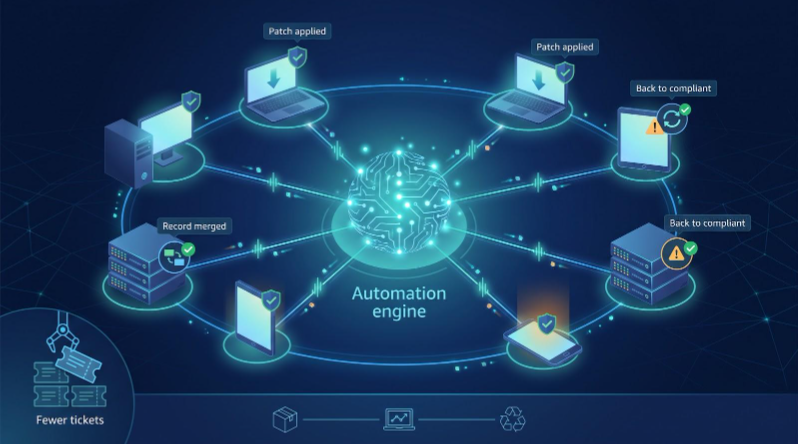
The result is a live inventory that stays a step ahead. A laptop skips a patch window? Neurons flags it, pushes the update through the same agent, and flips the asset back to compliant before anyone in security sends a chat. Duplicate records merge automatically, saving the CMDB from nightly reconciliation work.
Because Ivanti owns both endpoint management and the service-desk layers, device telemetry, incidents, and lifecycle data feed the same brain. You can trace a battery-swollen MacBook from purchase order to disposal, complete with every help-desk visit in between, all without swivel-chair clicks.
The sweet spot is the mid-enterprise. Teams with lean headcount want automation yet still need ITIL guardrails. Ivanti delivers bot-driven efficiency without the bureaucracy of larger suites. If you dream of assets that look after themselves, Neurons is the closest thing on the market.
5. BMC Helix ITAM: heavyweight governance for sprawling estates
Some organisations run data centres that feel more like small cities. For them, asset drift appears not in laptops but in racks. BMC Helix grew up in that world and still caters to it through almost obsessive process control.
Helix links every server, switch, and software component to a single CMDB spine. Change a memory module, decommission a VM, or renew a support contract. Each action triggers an approved workflow and automatically updates the financial record. Auditors value the traceability; operations teams value the drop in war-room surprises during outages.
Discovery is another strong suit. BMC scanners map multi-tier applications, showing which database sits under which middleware and which physical blade powers the lot. When security flags a vulnerable library, Helix pinpoints the exact stack instead of flooding your inbox with guesses.
Yes, the platform carries legacy weight. Implementation needs clear ITIL practices and admins who speak BMC fluently. Large enterprises often have those muscles already. For them, Helix provides enterprise-grade rigor without bolting on extra tools.
Think of BMC Helix as the option for organisations where a single undocumented switch can sink a compliance audit. If your asset count reaches six figures and your risk tolerance is near zero, this suite earns its keep.
6. ManageEngine AssetExplorer: enterprise basics on a startup budget
Not every company needs a luxury ride. Sometimes the win is simply moving off spreadsheets without signing a six-figure cheque. That gap is where AssetExplorer shines.
Installation takes an afternoon, not a quarter. Point its scanner at your network or deploy lightweight agents, and devices start appearing in the console with hardware specs and installed software already mapped. Add licence counts, and the dashboard flips green or red to flag compliance. Simple, visual, done.
Cost steals the spotlight. Annual licences often total less than a single penalty for unreturned gear, yet you still get purchase-order tracking, warranty alerts, and contract reminders, the fundamentals that stop small issues from ballooning.
There are trade-offs. Advanced automation, AI insights, and sleek UI polish live elsewhere on this list. Large estates with tens of thousands of devices will press the platform’s comfort zone, and you may lean on companion tools for mobile or cloud governance.
For mid-market IT teams chasing quick wins and audit readiness, AssetExplorer offers an honest proposition: solid coverage, predictable pricing, and no excuse to cling to that brittle Excel sheet.
7. Freshservice: modern service desk meets capable ITAM
Freshservice lands on many shortlists because the first demo looks, well, friendly. Clean pages, quick searches, and a self-service portal that feels more app store than ticket queue. Under that gloss sits an asset module that covers more ground than most expect.
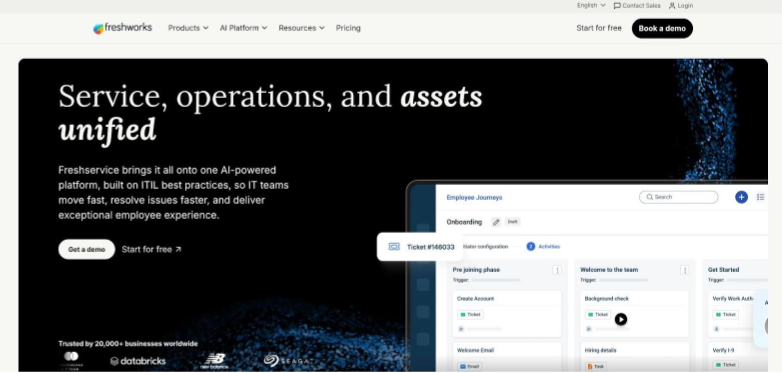
Its discovery probe scans networks, laptops, and cloud workloads, populating a CMDB-lite view complete with dependency maps. Link those assets to incidents and changes, and support agents see context the moment a ticket arrives. Fewer blind stabs, faster fixes.
The platform’s AI helper, Freddy, adds small efficiencies that stack up. It auto-classifies tickets, suggests solutions, and flags assets that repeatedly fail handy when you need data to justify a refresh program, not just gut feel.
Freshservice excels at time to value. Many teams launch service desk, asset tracking, and change workflows inside a month. Pricing is per agent, so costs scale with headcount, not device sprawl. The trade-off is depth. Complex licence metrics or data-centre-grade discovery stretch its native reach, though integrations can fill gaps.
For fast-growing companies that value intuitive UX and want ITAM woven into day-to-day support, Freshservice hits the sweet spot without drowning staff in config screens.
Quick comparison at a glance
Choosing a platform often comes down to two minutes in a budget meeting.
The table below distils the seven tools into the factors senior teams debate first: security stance, logistics help, commercial model, headline differentiator, and ideal fit.
| Vendor | Security & compliance highlight | Built-in logistics? | Pricing lens | Signature strength | Ideal org size |
| Allwhere | Chain-of-custody plus NIST-grade data wipe | Yes | Subscription per device plus service fee | End-to-end physical service wrapped in software | 500–10 000 remote employees |
| ServiceNow ITAM | ITIL-aligned approvals and audit trails | No (integrate) | Premium per module | Deep workflow automation across ITSM | 1 000+ with mature processes |
| Flexera One | Real-time licence compliance and audit defence | No | Modular SaaS by asset count | Cost-saving analytics for SaaS, cloud, on-prem | Software-heavy enterprises |
| Ivanti Neurons | Policy-driven self-healing assets | No | Mid-tier per node | Automation bots that fix issues on the fly | Lean IT teams, 500–5 000 devices |
| BMC Helix | CMDB-linked change governance | No | Enterprise tier | Data-centre discovery with strict ITIL control | Six-figure asset counts |
| ManageEngine AssetExplorer | On-prem option for full data control | No | Budget-friendly per asset | Rapid deployment without complexity | Mid-market moving off spreadsheets |
| Freshservice | Role-based access plus AI incident ties | No | Per agent | Modern UX with AI-powered service desk | Fast-growing firms 200–2 000 |
Conclusion
The right IT asset management platform depends on what an organization needs to control, automate, and account for. Some teams need stronger hardware lifecycle management across a distributed workforce, while others prioritize software licensing, compliance, service desk integration, automation, or large-scale infrastructure management.
The seven platforms covered here approach those requirements differently, so there is no single choice that fits every enterprise. Comparing security controls, integrations, lifecycle coverage, pricing, and operational complexity can help IT teams narrow the list and select a platform that fits their existing environment, resources, and long-term asset management goals.


