





Press play to start listening
Telecommunications operators are dealing with explosive data growth across billing systems, network operations, IoT devices, and digital platforms. Yet much of this data remains siloed and inconsistent, limiting its strategic value.
Data Fabric, a metadata-driven, AI-enabled approach to data integration, has emerged as the key to unlocking real-time intelligence in telecom. By unifying fragmented BSS and OSS environments, Data Fabric creates an adaptive, cloud-ready architecture that connects insights across customer experience, operations, and network management. This article explores how telecoms can use Data Fabric to modernise their data foundation, accelerate 5G innovation, and simplify governance at scale.
1. The Data Dilemma in Telecom
Telecom enterprises have always been rich in data but poor in insight. Decades of organic system growth have left carriers with hundreds of data repositories: billing, customer support, CRM, IoT, network logs, each optimised for a single function but isolated from the rest. Traditional data warehouses offered centralised reporting but required extensive ETL pipelines. Data lakes improved flexibility but soon became data swamps as duplication and governance issues multiplied.
As digital services expand and 5G networks become more complex, this siloed approach is no longer sustainable. The telecom industry needs a unified, intelligent data layer that provides real-time access, trusted lineage, and cross-domain visibility without massive re-engineering. That layer is the Data Fabric.
2. What is a Data Fabric?
A Data Fabric is a metadata-driven architecture that connects disparate data sources across cloud, on-premises, and edge environments through a single, intelligent framework. It doesn’t require moving data into one location; instead, it virtualises access to it.
Key capabilities include:
- Federated data access through APIs and virtualisation tools.
- Metadata and AI to automate discovery, quality checks, and lineage tracking.
- Policy-based governance to ensure compliance across multiple domains.
- Unified semantic models that make data usable for analytics, AI, and automation.
In telecom, a Data Fabric serves as the connective tissue between BSS (Business Support Systems) and OSS (Operational Support Systems), bridging traditionally isolated operational and customer data.
3. Data Fabric Architecture for Telecom
A well-designed telecom Data Fabric integrates existing data infrastructure through five logical layers:
- Ingestion Layer – Connects real-time sources like network telemetry, CRM, and billing systems.
- Metadata & Catalogue Layer – Maintains unified data lineage and quality information.
- Virtualisation & Integration Layer – Provides federated data access without duplication.
- Orchestration Layer – Automates data pipelines and governance workflows.
- Consumption Layer – Serves trusted data to analytics, AI, and reporting platforms.
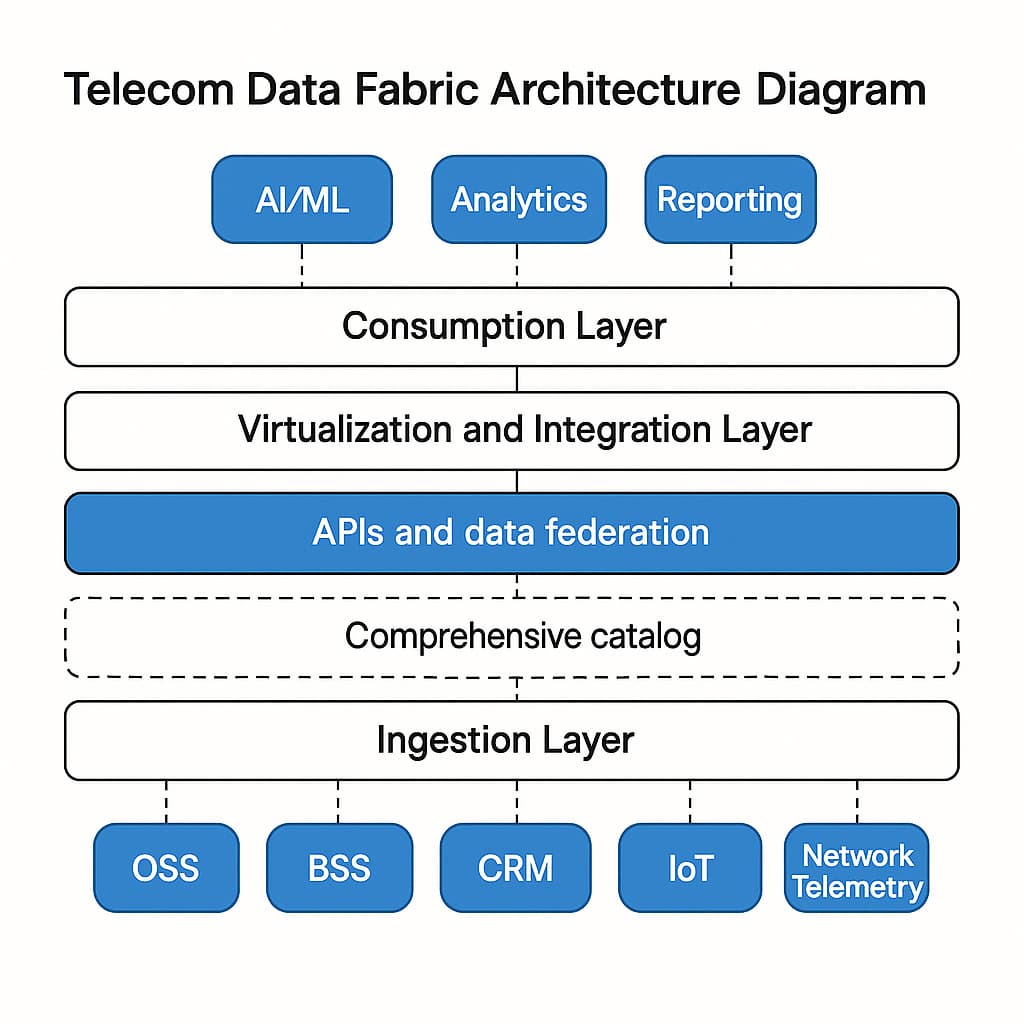
A layered schematic illustrating how Telecom Data Fabric unifies diverse systems. The architecture connects OSS/BSS, CRM, IoT, and network telemetry through five logical layers: Ingestion, Metadata & Catalogue, Virtualisation, Orchestration, and Consumption, enabling unified access, automated governance, and real-time data delivery across hybrid environments.
4. Business Use Cases in Telecommunications
Customer 360 and Personalisation: Data Fabric unifies customer profiles across billing, CRM, and interaction channels, enabling personalised experiences and proactive service recommendations.
Network Performance and Predictive Maintenance: Integrating OSS and IoT telemetry through a shared data layer allows predictive analytics to detect anomalies and prevent outages.
Fraud Detection and Revenue Assurance: Unified data views across payment, provisioning, and partner systems help identify revenue leakage and fraud faster.
Regulatory Compliance and Governance: Automated data lineage supports telecom regulations such as GDPR and CCPA, minimising audit complexity.

A comparative visualisation contrasting traditional siloed telecom data systems with a modern metadata-driven Data Fabric approach. The left side depicts disconnected BSS, OSS, and CRM silos, while the right shows an interconnected, AI-driven fabric that provides unified access, governance, and insight across all domains.
5. The Competitive Edge
Telecom operators that implement Data Fabric gain more than operational efficiency; they gain strategic agility.
- Real-time insights improve network optimisation and customer satisfaction.
- Faster analytics deployment accelerates new digital service launches.
- Lower integration cost replaces brittle ETL pipelines with virtualisation.
- Cloud-agnostic scalability supports hybrid and multi-cloud environments.
As telcos evolve toward autonomous networks and AI-driven operations, the Data Fabric becomes the essential digital backbone enabling closed-loop automation, intent-based orchestration, and cross-domain intelligence.
6. Learning from Other Industries
Industries like banking and healthcare faced similar challenges of siloed, sensitive, and regulated data. Their adoption of Data Fabric demonstrates its scalability and adaptability. Banks use it for real-time fraud analytics; hospitals use it for patient record federation. Telecom operators can take the same principles: metadata management, governance, and intelligent automation and apply them to unify customer and network intelligence.
7. Looking Ahead
With 5G, IoT, and edge services converging, the volume and velocity of telecom data will continue to surge. Data Fabric provides a sustainable way forward: a modular, metadata-rich framework that evolves with the business. By implementing Data Fabric, telecom operators can finally transform data chaos into a strategic advantage, driving innovation, automation, and superior customer experiences.
References
- Theodorou, V., Gerostathopoulos, I., Alshabani, I., Abelló, A., & Breitgand, D. (2021). MEDAL: An AI-driven Data Fabric Concept for Elastic Cloud-to-Edge Intelligence. arXiv. https://arxiv.org/abs/2102.13125
- ETSI. (2019). GS ZSM 002 V1.1.1: Zero-touch Network and Service Management (ZSM) – Reference Architecture. ETSI. https://shorturl.at/hUYPi (PDF)
- ETSI. (2021). GS ZSM 009-1 V1.1.1: Closed-Loop Automation Enablers (Part 1). ETSI. https://www.etsi.org/deliver/etsi_gs/ZSM/001_099/00901/01.01.01_60/gs_ZSM00901v010101p.pdf
- Enterprise Architecture Professional Journal. (2020, November). Big Data Fabric Architecture. https://eapj.org/wp-content/uploads/2020/11/Big-Data-Fabric-Architecture.pdf
- Kleppmann, M. (2017). Designing Data-Intensive Applications. O’Reilly Media.