





Press play to start listening
Learn how live video moderation handles frame sampling, end-to-end encryption, behavioural signals, privacy and content retention in video chat.
Most content-moderation systems were developed around material that can be inspected before publication or reviewed after it has been uploaded. Live video gives platforms far less time to act.
Images and recorded videos can be hashed, compared with databases of known illegal material and sent for human review. Microsoft, for example, says it uses PhotoDNA and MD5 to identify known harmful image and video content on its consumer services.
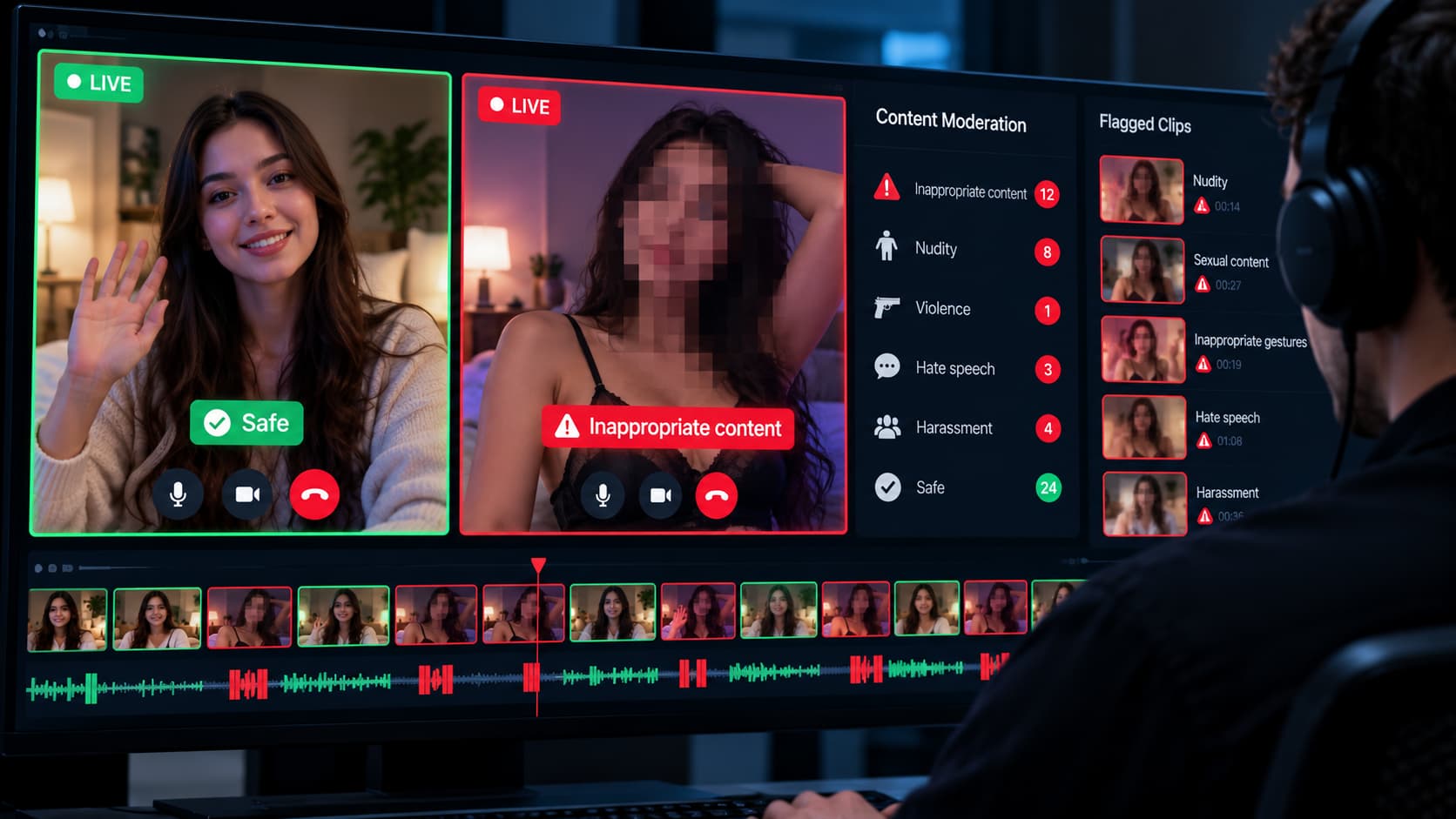
Live services can also inspect frames or short video segments while a session is active. The technical problem is timing. Detection must happen quickly enough to interrupt the broadcast, warn participants or limit further exposure, even though some frames may already have reached viewers.
That time pressure affects how detection models, human review, encryption and retention can be used. Live moderation is not impossible, but it requires different technical and policy choices from moderation built around uploaded files.
Live Video Leaves Little Time to Act
Interactive video is sensitive to delay. Capture, encoding, transmission and playback already consume part of the available processing time, leaving moderation systems to work without making the conversation noticeably slower.
Human reviewers cannot assess every live session before content reaches another participant. Automated systems therefore perform the first assessment, with people handling reports, disputed decisions and cases referred for further examination.
Platforms may also respond without immediately ending a session. A detection result could increase monitoring, blur video, display a warning, restrict an account or send the activity for review. The available response depends on the severity of the material and the confidence of the detection model.
AWS has published an example live-content moderation workflow that extracts frames from a live channel, analyses them, stores selected frames and stops the broadcast when specified content is detected. It shows that live analysis is technically possible, although the design still has to account for processing cost, delay and detection errors.
Frame Sampling Creates a Detection Gap
Many services reduce processing demands by sampling frames or short clips instead of analysing every frame. The chosen rate depends on available computing power, session volume, device capabilities and the type of harm being detected.
Sampling introduces an unavoidable trade-off. Inspecting fewer frames reduces processing costs but creates a longer period in which prohibited material could appear and disappear between checks. Increasing the rate gives the system more opportunities to detect that material but requires more computing resources.
Fixed sampling is not the only option. A platform can begin with a lower rate and increase it when other signals indicate greater risk. A new account receiving several reports, repeated rapid disconnections or suspicious device activity could trigger more frequent analysis.
Anyone assessing a platform’s moderation claims should therefore ask how often content is examined, which events increase that frequency and what happens after a model returns an uncertain result.
Where the Detection Model Runs
The location of the moderation model affects privacy, performance and resistance to tampering. The three main approaches are server-side, on-device and hybrid processing.
| Approach | Detection capacity | Privacy exposure | Evasion risk |
|---|---|---|---|
| Server-side | Access to centrally managed computing resources and models that can be updated without changing the client | The platform can access decrypted content submitted for analysis | Models remain under platform control, although attackers can still test the service through repeated interactions |
| On-device | Performance depends on the hardware, operating system and model size supported by the device | Raw video can remain on the device unless a result or selected content is reported | Modified clients may disable, extract or examine the model |
| Hybrid | Local screening can refer selected content for stronger server-side analysis | Server access can be limited to material referred by the client | The client-side component remains exposed, while the server still receives selected content |
Server-side processing gives a platform greater control over model updates and computing resources. It also requires access to video in a form the server can inspect, creating privacy, security and legal concerns.
On-device processing keeps raw content closer to the user, but the model runs on hardware outside the platform’s control. Attackers may modify the application, disable checks or study the model to identify inputs it handles poorly.
Hybrid systems use local screening before sending selected material for additional analysis. This can limit how much video reaches the server, but it does not remove the weaknesses associated with either location.
Why End-to-End Encryption Rules Out Server-Side Content Inspection
A platform cannot claim that only participants can access a session while also decrypting that session on its servers for content analysis. Server-side inspection of plaintext conflicts with the defining privacy guarantee of end-to-end encryption.
Client-side scanning has been proposed as a way to inspect content before encryption or after decryption on the recipient’s device. The approach has faced sustained opposition from security and privacy researchers.
In Bugs in Our Pockets, fourteen cryptographers and security researchers examined how client-side scanning could be evaded, repurposed or abused. They argued that placing a scanning capability on personal devices creates risks extending past the original categories of content it was designed to identify.
The paper appeared as a preprint in 2021 before being published in the Journal of Cybersecurity in 2024. Its objections apply to stored material and communications inspected on user devices, including video analysed before transmission.
End-to-end encryption does not prevent every form of moderation. User reporting, account restrictions and metadata analysis remain available without giving the platform routine access to session content.
A separate study of moderation in encrypted systems found that reporting and metadata-based methods were more likely to preserve the privacy and security properties expected from encrypted services.
Behavioural Signals Do Not Require Access to Video
Live services can examine how accounts behave without analysing what appears on camera. Useful signals may include session duration, repeated reconnections, report history, account age, device information and how frequently participants end conversations within the first few seconds.
Services operating video chat for large user bases can use these signals to support frame or clip analysis. A single image may be unclear, while repeated account behaviour can show a pattern that deserves review.
Behavioural analysis is not a complete substitute for inspecting content. It can identify repeated activity, coordinated abuse or attempts to return after suspension, but it may miss a first-time offender or a harmful event with no prior warning.
This form of monitoring also carries privacy obligations. Account histories, device reputation and behavioural profiles may involve additional data collection and automated decision-making. Platforms should document what they collect, why they collect it and how long the information is retained.
Retention Creates Another Privacy Decision
Reports often arrive after a session has ended. A platform that retains nothing may have little evidence available to investigate, while one that records every session creates an archive of private video that could be exposed, misused or demanded through legal processes.
A safer approach is to retain the minimum material needed for a documented purpose, restrict access, encrypt it and delete it under an enforced schedule. The retention period should reflect reporting delays, safeguarding requirements and legal obligations.
Some services may retain sampled frames or short encrypted buffers associated with a specific session. Access can then be limited to authorised reviews initiated by a user report or a high-confidence automated alert.
Users should be told whether sessions are recorded, whether sampled images are retained, who can access them and when deletion occurs. Those choices belong in the product’s privacy and security design, not only in an internal operations document.
Questions Platforms Should Answer
Live video moderation is not uploaded-image moderation performed faster. It combines time-sensitive detection, incomplete sampling, privacy limits and decisions about where analysis takes place.
Anyone evaluating a live-video service should ask where inference runs, how often frames or clips are examined, which events increase monitoring and how long any retained content remains available.
Those answers reveal more about a platform’s moderation and privacy choices than a general commitment to user safety.


