




Press play to start listening
Residents across Iran were jolted by a double shock early Saturday morning. As joint military strikes from the United States and Israel hit various locations, a popular mobile app used by over five million people was hijacked to broadcast messages calling for government forces to step down.
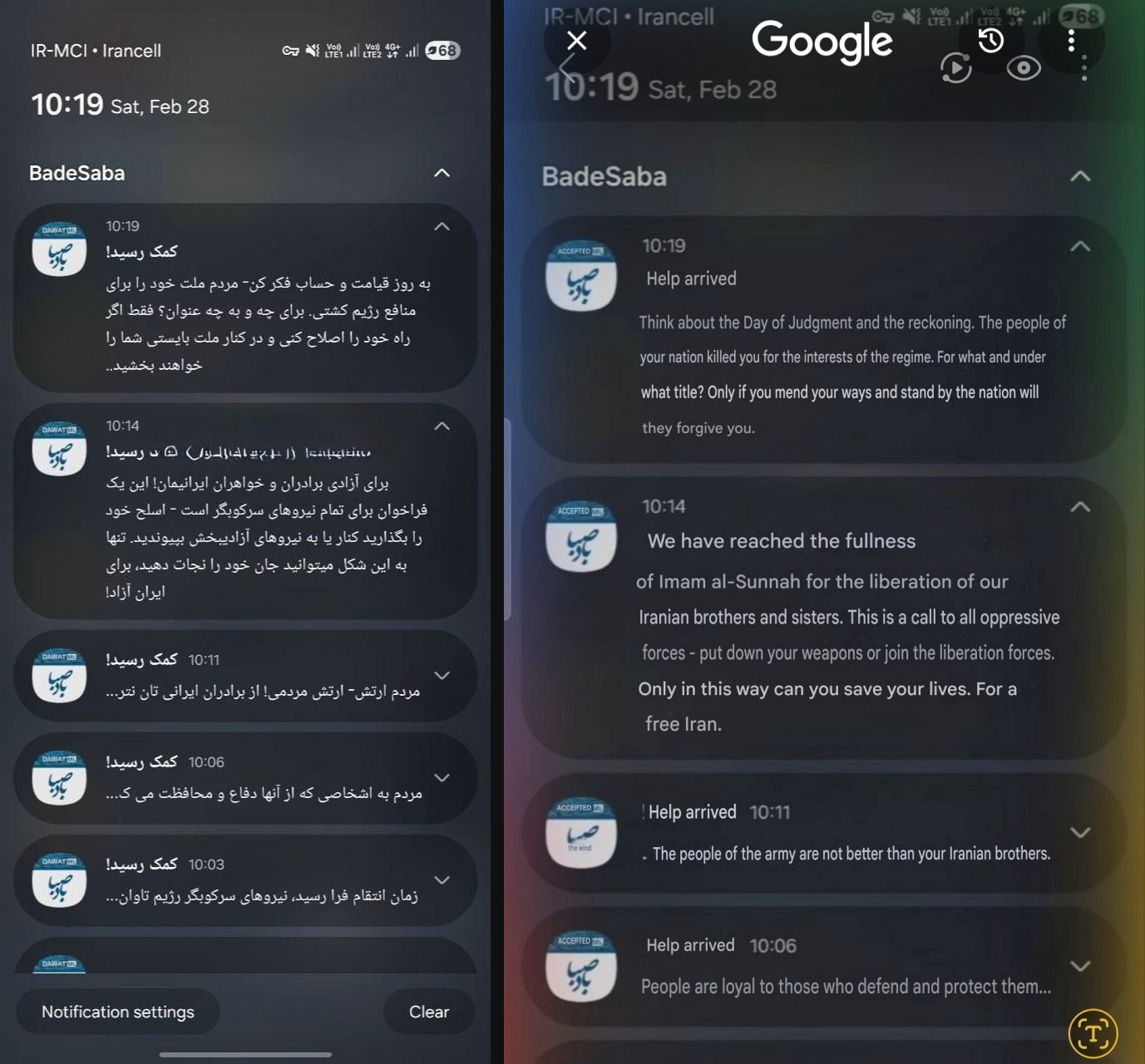
These alerts arrived just as the series of first explosions was heard, creating a sense of chaos both on the ground and on people’s screens. The focus of these alerts was the BadeSaba Calendar, an essential tool for many Iranians used for tracking daily prayer timings.
At approximately 9:52 AM Tehran time, the app stopped sending its usual religious reminders, and instead, it began flooding phones with alerts titled “Help is on the way,” which went on for 30 minutes. According to media reports, these notifications were specifically directed at military personnel rather than just the general public.
The messages urged soldiers to put down their weapons and join what was described as a liberation movement. Some of the alerts read:
“The time of judgment has come.”
“Lay down your weapons and join the liberation army. For a free Iran.”
“The regime’s repressive forces will pay for their cruel and merciless actions against the innocent people of Iran.”
The alerts promised that anyone who stopped fighting would be granted amnesty, which, in simple terms, means they would be forgiven for their past actions and protected from punishment. One specific message told users that the time for revenge had arrived, while later alerts told “oppressive forces” that surrendering was the only way to save their lives.
Further probing revealed that the hack extended beyond just one app. Several state-linked news agencies, such as IRNA and ISNA, were also knocked offline or changed to show anti-government content. While IRNA managed to get back online relatively quickly, other sites remained broken for much longer.
As these messages spread, the country’s internet began to fail. According to NetBlocks, a group that monitors global web traffic, connectivity in Iran plummeted to just 4 per cent of its normal levels. This meant that mobile data and home broadband became almost useless, making it nearly impossible for people to check the news or reach their families. The Wall Street Journal has blamed Israel for the prayer app hack.
Hijacking Media to Spread the Word
As technology has expanded, cyberwarfare has opened many new targets, including critical alert systems and even television broadcasts. In October 2023, during the conflict that intensified after the October 7 attacks, pro-Palestinian hackers breached the Red Alert app, a system that sends missile and rocket warnings to Israelis. The attackers used the access to send false rocket attack alerts to users.
Incidents involving hacked public displays have also occurred in other countries. In 2018, airport screens in Mashhad, Iran, were hacked and defaced with anti-government messages. A similar incident occurred in January 2024 in Lebanon, when screens inside Beirut–Rafic Hariri International Airport briefly displayed anti-Hezbollah messages instead of flight schedules.
(Photo by engin akyurt on Unsplash)


