Modern Enterprises: How to Evaluate the Security and Compliance of Office Software

Learn how modern businesses can judge office software for ISO 27001 certification, GDPR-aligned data handling, encryption, and safer PDF workflows with clarity.
Modern Enterprises: How to Evaluate the Security and Compliance of Office Software

Listen to this article

0:00

Press play to start listening

Disclosure: This article was produced in collaboration with UPDF. Product details and security information referenced in this article were provided as part of that collaboration.

As teams have spread out across home offices, personal devices, and shared cloud drives, the documents that hold a company’s most sensitive information have followed them into far less predictable territory. A single contract or financial report may now pass through several networks before it reaches the right person, and each handoff widens the window for a leak.

That reality leaves security leaders with one unavoidable question: can the office software their teams rely on every day be trusted to keep that data safe? A growing number of platforms, UPDF among them, answer that question by combining familiar PDF tools with security credentials that can actually be verified.

The principle, however, reaches well beyond any single product. Judging office software on its security and compliance has become a discipline in its own right, not a formality to rush through during procurement.

Core Criteria for Assessing Office Software Security

Before any document tool earns a place in your workflow, it should hold up against four questions that, taken together, reveal whether it can be trusted with confidential material.

  • Compliance certifications. Insist on credentials that are independently audited rather than self-proclaimed, and treat ISO 27001 as the benchmark for information security management. A certification you have no way to confirm is a marketing line, not a guarantee.
  • Encryption standards. Files should stay encrypted both while stored and while moving between locations, and the tool should let you lock down individual documents so they remain protected even after they travel beyond your own network.
  • Data handling transparency. A trustworthy vendor will spell out where your data lives, who is able to reach it, and how those practices line up with rules such as GDPR, instead of leaving you to guess.
  • Auditability. In regulated sectors, compliance teams need access logs and a clear record of changes that they can pull up and export whenever an audit demands it. These four checks form a framework you can reuse for every purchase, and UPDF serves as a useful illustration of what passing each one looks like in practice.

UPDF as a Secure Solution

UPDF works across every major platform and handles a document from start to finish: editing text and images, running OCR on scanned pages, applying watermarks, converting between formats, and reorganizing pages. Viewed through a security lens, that breadth matters because it lets a team keep sensitive files inside one trusted application rather than shuttling them through weaker formats or unfamiliar third-party converters.

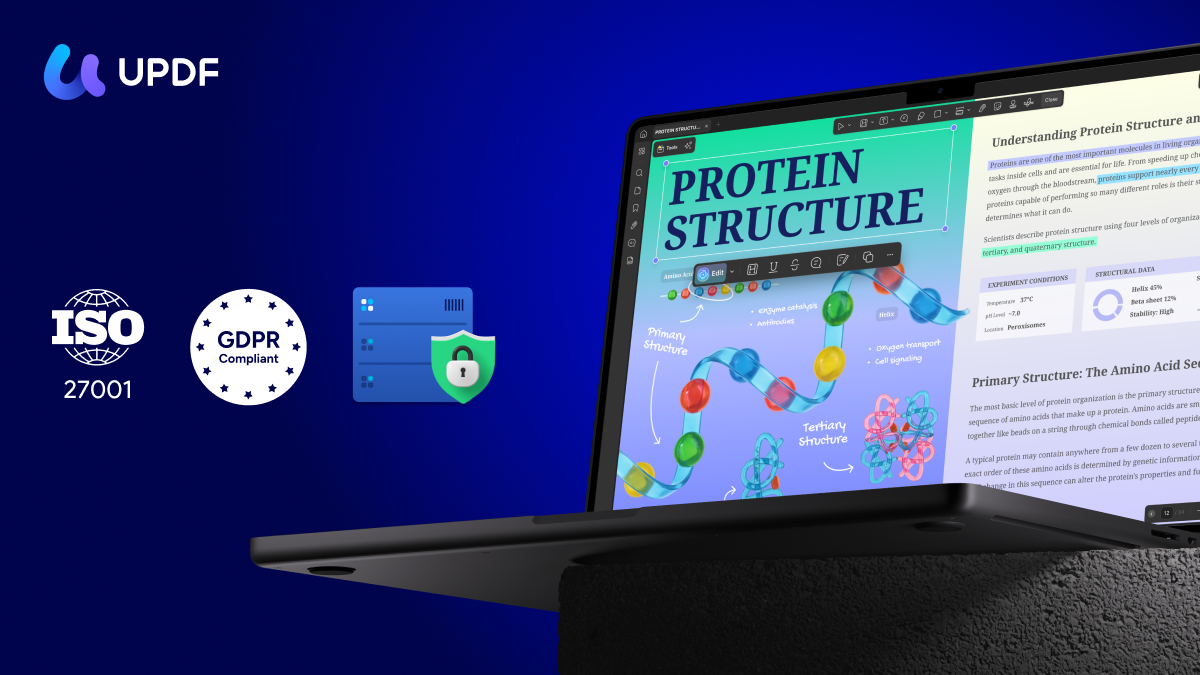
Where UPDF stands out for enterprise buyers is the foundation beneath those features. It carries ISO 27001 certification for its Information Security Management System, earned through an independent audit rather than self-assessment, which gives procurement teams a credential they can point to in any vendor review. Its handling of personal data follows GDPR principles, keeping collection to a minimum and processing transparent. 

On the encryption side, it offers two distinct password layers: an open password that decides who can view a file at all, and a permissions password that governs whether a viewer can print, copy, or edit it. UPDF Cloud then carries that protection across devices, keeping documents encrypted both as they sync and while they sit at rest.

For any organization that has to protect PDF files holding contracts or financial records, this two-password approach means the controls stay attached to the document itself rather than to the platform where it happened to originate.

Modern Enterprises: How to Evaluate the Security and Compliance of Office Software

Practical Application in Enterprise Workflows

Picture a legal team getting a contract ready for an outside reviewer. Inside UPDF, they edit and annotate the draft, then lock it with an open password handed to the recipient through a secure channel and a permissions password that switches off printing and copying.

The file moves through UPDF Cloud with its contents encrypted in transit, and any scanned attachments become fully searchable through OCR without ever being downgraded to an unprotected format. Should the document end up in the wrong inbox along the way, those safeguards stay firmly in place.

Modern Enterprises: How to Evaluate the Security and Compliance of Office Software

That same pattern carries over to quarterly figures sent to outside auditors, employee records shared between offices in different countries, and working documents passed back and forth by hybrid teams. In each of these cases, PDF security compliance and enterprise document encryption are not nice-to-have extras but day-to-day necessities.

Settling on a single tool that brings audited certifications and encryption together lets a company shrink its exposure and its compliance burden at the same time, while handing scattered teams one dependable, secure way to get work done.

Building a Security-First Document Strategy

Document security can no longer be treated as a final step in the buying process; it sits at the heart of enterprise risk management and remote work data protection. Weighing each vendor against audited certifications, encryption standards, transparent data policies, and audit-ready records gives security teams a consistent, defensible method they can apply to every tool they bring on board.

UPDF, as an ISO 27001 PDF editor built on GDPR-aligned practices and dependable encryption, shows that a tool can be genuinely capable and genuinely secure at the same time, without forcing a trade-off between the two.

Ready to strengthen your organization’s document security? Download UPDF’s free trial today and experience ISO 27001-certified PDF protection with robust encryption and seamless enterprise workflows. Start your no-risk trial now and take a confident step toward better compliance and data security.

Leave a Reply

Your email address will not be published. Required fields are marked *

Related Posts