






Press play to start listening
Google reports hackers using an AI agent to study new patches, identify software flaws and automatically develop and run exploits without human input.
Google Threat Intelligence Group says it has observed a threat actor using an AI framework to identify software vulnerabilities, write exploits and execute them without a person directing each step.
Published on November 16, Google’s latest AI Threat Tracker describes a framework called exploit_agent that examines software changes after security patches. It compares the old and updated code, looks for the weakness addressed by the fix and attempts to turn that finding into an exploit.
GTIG describes this as its first observation of threat actors fully automating vulnerability research and exploitation without a human in the loop. That is a finding from Google’s investigations, not a claim that nobody has previously attempted autonomous exploitation.
Turning software fixes into attack instructions
A published patch gives attackers useful information about what was wrong with an application. By examining the changes, they can work backwards to understand the flaw and target systems whose owners have not installed the update.
With exploit_agent, the operator configured an LLM framework to repeat that work automatically. Russian-language configuration comments accompanied the tooling, although the language alone does not establish the operator’s nationality.
Google’s report found the framework on an exposed staging server alongside stolen victim data and scripts for further malicious activity. Material on the server suggested an interest in French media, entertainment and education websites. The report does not provide a success rate for the framework or establish that every generated exploit worked.
Open-source agents appear in active attacks
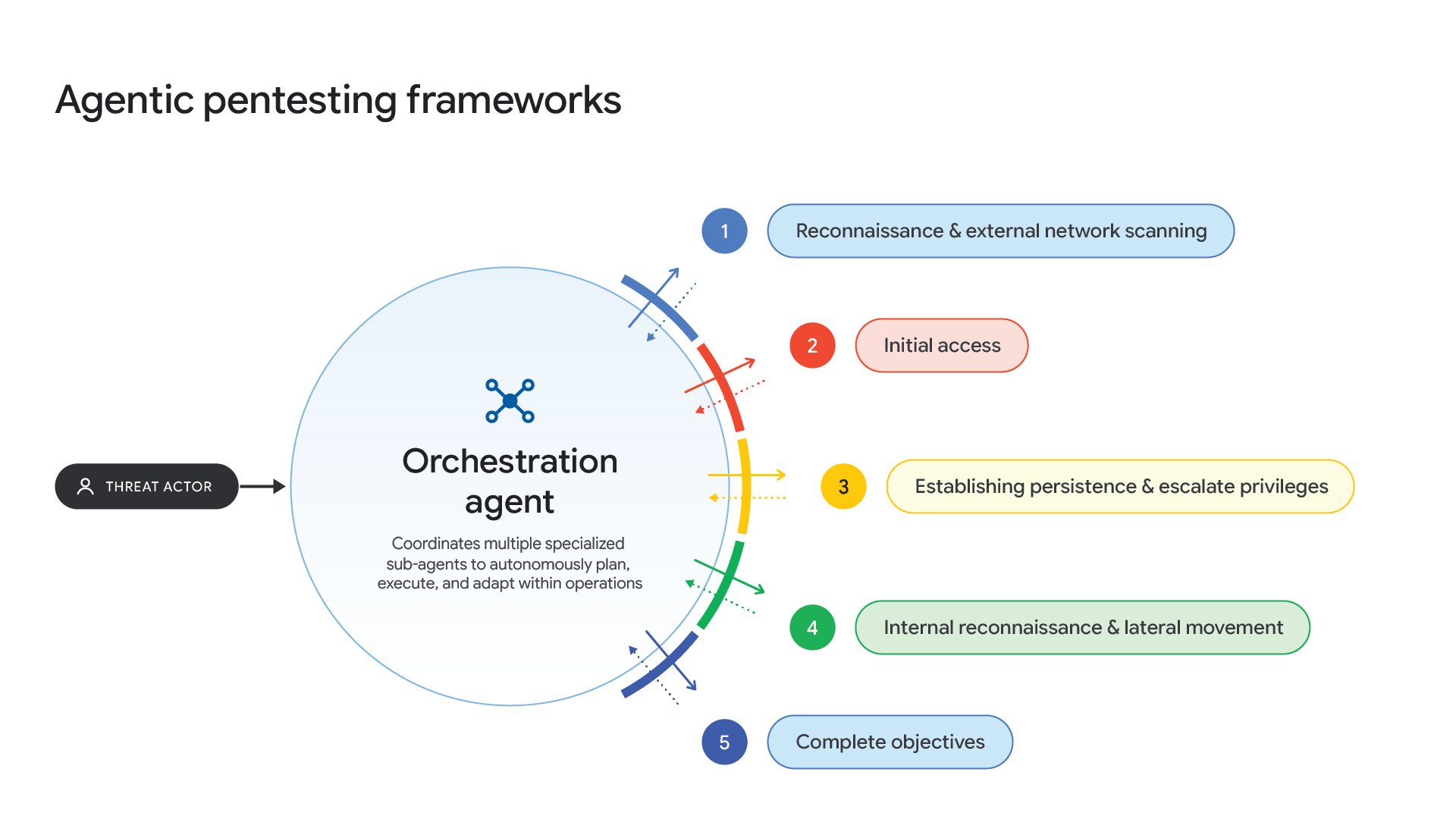
Alongside the custom framework, Google also tracked cyber criminals and suspected espionage actors using publicly available AI tools to automate parts of their attacks.
Its researchers observed CAIRN being used against targets that included the US aerospace sector. They also saw PentAGI deployed in the wild, with experimentation involving CyberStrikeAI and other frameworks.
These tools connect language models to security utilities, allowing them to select actions and respond to results. Their availability gives attackers a way to automate tasks without building every component themselves.
Google also cautions that automated tools can produce conspicuous activity and unreliable results. However, faster execution does not mean every attack succeeds or avoids detection.
Fake personas and automated influence campaigns
Other investigations in the report show AI being used to support influence campaigns, including the development of services for creating personas and publishing content.
In one case, a commercial contractor used the Gemini API while developing a platform designed to manage more than 100,000 accounts through cloud-based virtual phones. That figure describes the platform’s intended capacity, not a confirmed count of active accounts.
A separate operation used prompts requesting regional language, informal phrasing and deliberate mistakes. Image-generation instructions included simulated smartphone camera flaws, such as grain and uneven lighting, to make synthetic material look more ordinary.
Stolen information becomes material for further attacks
Google also observed China-aligned actors using language models to process stolen information into intelligence products. North Korea-aligned activity included AI-generated personas targeting cryptocurrency businesses and attempts to manipulate autonomous coding assistants’ configuration.
Google says it disabled accounts associated with misuse of its services and used the findings to improve safeguards.
Companies should check which applications need updating and apply security fixes promptly, especially on systems accessible from the internet. If an update has to wait, limiting access to the affected application can help. They should also check for signs of an earlier compromise, because patching a flaw does not remove an attacker who has already gained access.


