





Press play to start listening
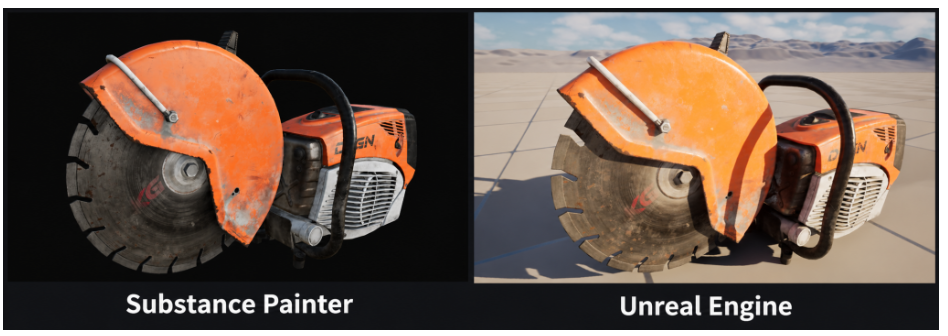
Anybody familiar with material creation knows the feeling. Hours of work have gone into a surface in Substance Painter; colour is perfect, Roughness gives that right breakup, and little details react exactly as they should on the viewport’s lighting.
But then the textures get exported to Unreal Engine, the material is applied – and something is just wrong. It may appear darker than expected. Too many reflections or no fine surface breakup at all may happen suddenly. The believable metal turned almost black; paint turned too shiny.
This leads to the obvious question: is it a wrong material or wrong lighting? I have been asked this question in production many times and the issue lies in this premise: material and lighting can be considered independently.
We can study them independently, but the result exists only in their combination. What we see is created by a surface interacting with lighting, with surroundings, with the camera and with image processing. A material does not have an inherent visual appearance. This is why I prefer to see a material as a description of how a surface reacts to lighting.
One Surface, One Spectrum of Reactions
Place a grey sphere in some light, and its volume will read instantly. Make only one adjustment – the surface of the sphere – from matte plastic to metallic and the whole object feels totally different even though its shape and the light source have not been changed. The light is used to describe the form. The surface influences how it reacts to the light.
Some part of perception consists of colors; another part of reflections. The finish affects how crisp or diffused this reflection is, while small reliefs affect the behavior of light on the surface.
To trace all of these aspects throughout the rest of the essay, I am going to continue looking at just one object – a rusty control panel made of painted metal with some reliefs and scratches.
Base Color Is Not the Whole Material
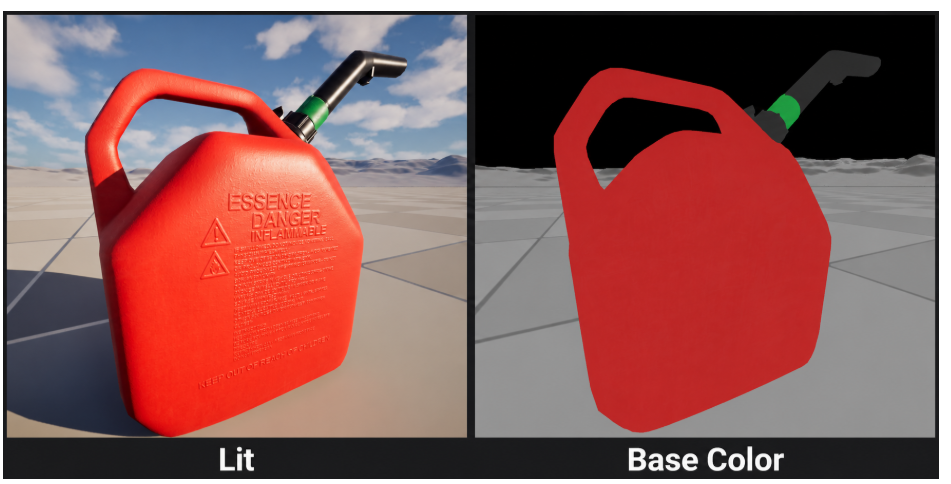
Base Color is something that gets a lot of focus due to its obviousness. Once you open the texture, it is clear – you see stains, gradients, changes in pigmentation, dirt, patterns and breakup. All this makes Base Color the element where artists try to make the material look complete. In a quiet area, there is no noise, so the artist adds some, then a stain, then more color variations. Texture becomes busier, and the material becomes less believable.
Many man-made surfaces have very simple color schemes. For example, the powder-coated paint applied on the control panel might be almost uniform in its colors. It is the reaction of the surface to light, people’s touch, damaged areas, places where coating is absent and where steel is exposed that makes the texture interesting.
Some materials require complex color information: wood, marble, terrazzo, patterned fabrics, materials with natural mottling – these are the evident examples. The criterion is one question: is it color variation that we see here? If yes, then it should go to Base Color. Otherwise, the variation is not color at all.
Reflection plays a much more important role in making the material look rich.
Diffuse, Specular and the Metallic Decision
It helps to separate two things we normally see together: a surface’s colour response and its reflections. On a typical non-metal surface, much of the visible colour comes from the diffuse response. The specular component is the reflected light and environment – highlights, bright shapes, windows and other parts of the world around the object.
Unreal Engine makes this distinction useful in practice, not only in theory. The viewport lighting components can isolate Diffuse and Specular, which makes it much easier to see whether a problem originates in the colour response or in the reflections.
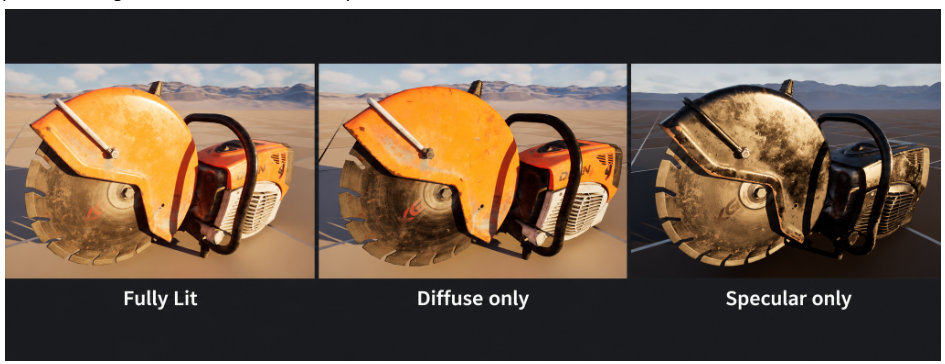
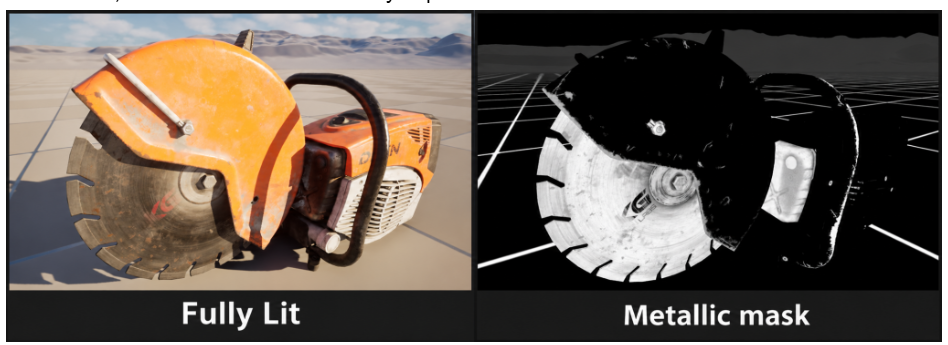
On the painted part of the control panel, most of the visible colour belongs to the non-metal surface response, while the reflections are shaped by the lights and environment around it. Now look at a scratch where the coating has been removed and bare steel shows through. The relationship changes: much of the normal diffuse colour response disappears, reflection becomes dominant, and the colour of the metal is carried by that reflection.
A useful mental model is to think of bare metal as a coloured mirror. That does not mean every metal should look polished or chrome-like. A rough metal can have a broad, soft reflection; a polished metal can have a sharp one. That difference belongs to Roughness.
Metallic answers a different question: what surface is the light actually hitting? For a clean, homogeneous surface, it is normally an either-or decision – 0 for non-metal, 1 for exposed bare metal. Where steel is covered by opaque paint, the light is interacting with paint, so that region behaves as a non-metal. Where the paint has been scratched away and steel is exposed, that region behaves as metal. What matters is not what the object is made from underneath, but what material is actually exposed at the surface.
Roughness: Judging Reflection, Not the Texture
The basic model of Roughness is the blurring of the reflection. With low roughness, the reflections retain some degree of sharpness, whereas increased roughness will spread them into blurred and broad reflections. However, it should be stated that the Roughness parameter does not measure reflection intensity.
See it in action
Some materials with amazing roughness maps turned out to have most of the detail vanish once the texture is animated with lighting of the real game. It does not mean that there was something wrong with the texture, but rather that it was judged as an image rather than as a light reaction.
Rotate the object, change the camera, change the lighting position and see how the reflection travels along the surface. The simple map becomes credible all of a sudden, while the complex greyscale texture proves to be only visual noise. Do not judge Roughness by its map. Judge the reaction of the reflection to the movements of the object.

Begin with the original finish
Determine the original finish based on the properties of the surface materials and their production, before considering any wear factors. A plastic surface might come out of the factory as glossy, satin or textured. A powder-coated steel surface might be very matte in its finish. The stone might be polished enough for clear reflections or honed to reflect widely. Wooden surfaces can be left unfinished, treated with oil, varnish or lacquer. This determines the expected response before any wear.
Then consider the effects of use. Handling could polish the matte finish surrounding a button. Dust may make a horizontal surface look dull. Greasy areas due to handling of a control mechanism will have their own effects on the surface. Weather, cleaning, abrasions and water will each affect the surface in its own way. Aging is not just about making something rougher.
Surface roughness is evidence of the original finish as well as subsequent history. It can indicate maintenance, interaction, cleanliness, neglect, weather and use even when Base Color is almost unchanged.
Normal: Designing Surface Relief
A simple relationship is worth keeping in mind: Base Color gives you color. Roughness gives you surface finish. And finally, Normal gives you surface relief. Relief in this case means surface shape on small scales to which lighting reacts.
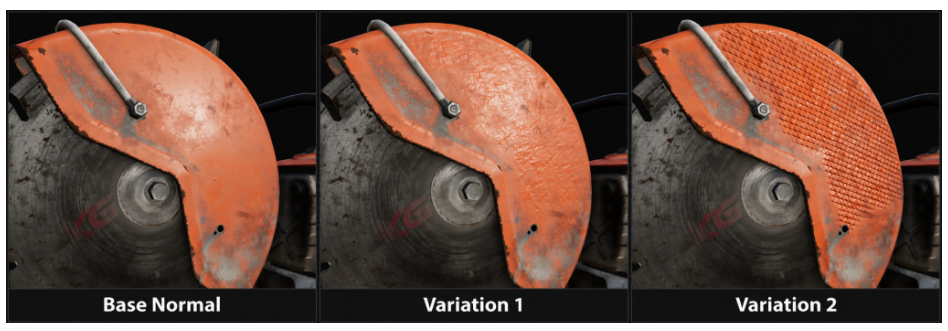
Normal maps are often presented as a technical trick to get high-poly geometry baked into a texture to be used as a detail layer without bringing geometry into a game. It is an effective approach, but it does not represent the full capabilities of Normal maps. Even keeping Base Color, Metallic and Roughness unchanged, the Normal map may bring dramatic changes to surface appearance.
Imagine a painted panel whose color and finish will stay intact. There may be a panel with a nearly perfect surface. There may be a panel with fine powder coating. There may be shallow grooves, stamped ribs, pressed patterns or lettering embossed on the panel. The highlights would reflect differently depending on the relief and the whole surface appearance will vary accordingly. With different angle of camera or lighting source, the same material would appear flat, industrial, precise, decorative or engineered because of different relief.
Natural surfaces also use the same technique. The grain of leather, stone pores, wood fibers, woven patterns, hammered and machined textures all reflect light differently on a small scale and help to determine surface feel.
Using Normal map, it is possible to establish manufacturing look, natural surface patterns, scale, decoration or design and subtle material properties without introducing any color variations. Nearly homogeneous material may get much more visual diversity due to different relief and reflections.
The damage can affect relief too. But damage is just one possible application. Normal map is as important for describing the surface in its undamaged state. It is not only a way to simulate additional geometry but a way to design surface lighting.
Build the Event, Not the Texture Map
It would seem that one common theme appears across multiple critique discussions. For example, the artist begins looking through the Roughness map and notices that some space looks “too flat.” They add some details. Next, the Normal map requires “scratches” in order to accommodate those details. Also, the Base Color needs variations. As a result, all textures become progressively more complicated without having any real-life reference at all.
This approach, however, is backward. Start with the event – what happened to this surface and, then decide what changed.
A fingerprint may primarily change the finish, so Roughness does most of the work. Sun-faded paint has genuinely changed colour, so Base Color becomes important; if the finish degraded as well, Roughness may change too.
A light scuff may mostly alter the finish, while a deeper scratch can change both finish and relief. If that scratch cuts through the paint, several properties change at once: the paint colour disappears, the surface is damaged, the finish changes and bare steel is exposed. Now Base Color, Roughness, Normal and Metallic may all participate, because the physical event justifies each one.
These are examples, not recipes. There is no need for a scratch to go into every texture just because it is a scratch, nor is there a need for dirt to do the same. While thin stain affects Base Color mostly, greasy dirt affects Roughness considerably and mud with some thickness – relief too. Channels should follow the physics.
Not all textures should be filled with all sorts of information, but instead, we should consider usage, exposure, contact, protection, wear and tear, and maintenance. Where was the thing held? What got polished due to contact? What faded away? What was protected? Did any other material get exposed underneath? This will provide variation with purpose. But once we have put all the information in the texture, one more question comes to mind: can the lighting reveal it all?
Lighting Reveals the Information in Materials
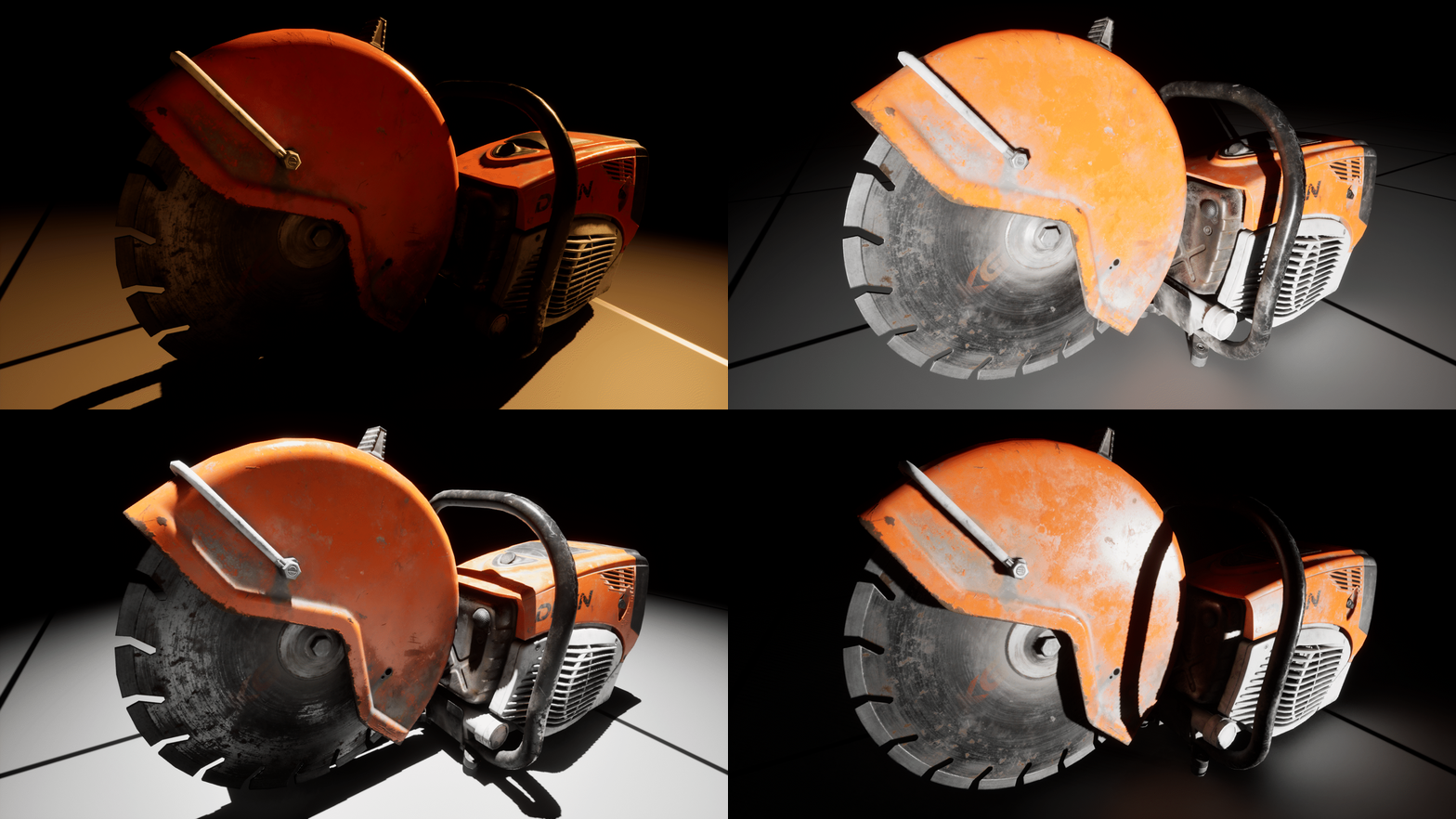
Materials determine the reaction; lighting reveals it. A material may have perfectly valid information stored within it but still be hard to interpret if the scene fails to provide proper lighting for revealing it. Color is not perceived in a vacuum either. The same Base Color may seem lighter, darker, warmer, or colder based on lighting and the environment around the object.
A world is needed for reflections
This is even more evident in the case of Reflections. Put the control panel in a nearly empty, dark scene and its exposed steel may look almost black. Leave the material alone but add some reflection information to the environment – bright windows, contrasting buildings, the sky, architecture, and big light sources, and the metal suddenly starts to make sense. Nothing has changed about the material. A reflective material cannot create a good reflection by itself; it requires a world to reflect.
Roughness relies on that world too. If Roughness controls how sharply or broadly the environment is reflected, the environment first has to contain something worth reflecting.
Direction is necessary for relief
Normal requires direction just as much as light does. Direct lighting of the smooth-coated grain, ribs, or embossed texture from nearly the front will not reveal much of its structure at all. As you move the light to the side, it becomes easier to see the relief. When you move the light along the surface, the texture appears.
Nor is the relationship entirely one-way. With coloured bounce, a large saturated surface can tint nearby objects, so the material itself becomes part of the lighting environment.
Everything doesn’t need to be revealed
Lighting doesn’t need to reveal everything about the environment. Composition, mood, gameplay, horror or hierarchy might require some information to remain silent. Lighting isn’t there to demonstrate whether each texture functions or not. Lighting reveals which information becomes apparent within the image.
The Image that the Player Actually Sees
Exposure, tone mapping and color grading go on to affect the outcome once material and lighting have combined. This affects the brightness, highlights, contrast, saturation and warmth of the image and, finally, the separation of the surfaces.
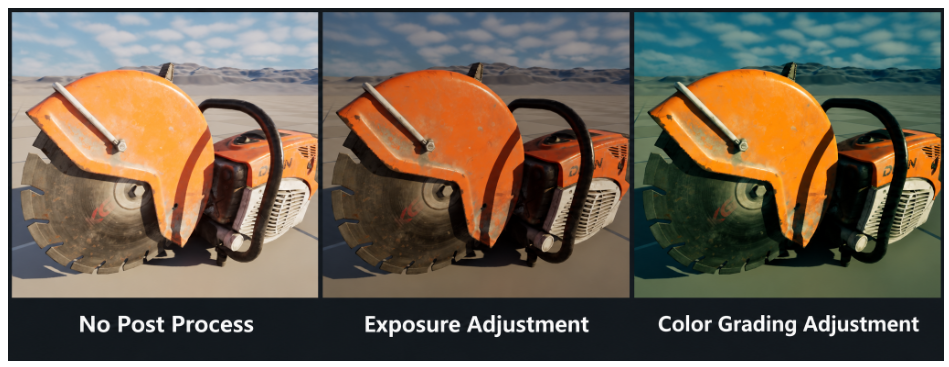
This leads us back to the material we talked about earlier on; it looked good in Substance Painter and different in the game. This does not necessarily mean that there was anything wrong with the authoring of the material. The material might be behaving differently because of different factors such as different lighting, reflection environment, exposure, tone mapping and finally color grading.
The controlled material viewport is still very valuable. It provides an environment where one can be able to study the behavior of the material being inspected. However, the viewport and the actual game address two different issues. The viewport determines the behavior of the material and the game determines whether it works in the image the player sees.
Consider all of them together at an early stage
Materials, lighting, and post-processing should not be considered as different steps of the production process. All of these three aspects should be considered together at an early stage, when one could still influence another. It is not necessary to create all of the materials and lighting first and only then move to the post-processing. One should only get some sense of the interaction of all these factors and evaluate them.
This way, it is important to go through all these aspects several times, making improvements every time.
The idea here is not to repeat the same cycle forever, but to find out how they all work together.
The Material Was Never Alone
The next time a material leaves Substance looking perfect and arrives in the game looking completely different, the first question does not have to be “Which texture is wrong?”
Look at the surface and ask what physically happened to it. Look at what it is reflecting and how the light moves across it. Then look at the final image and ask what the player actually needs to see.
Colour is only one part of a surface’s identity. Its finish shapes reflection. Its relief changes the way light travels across it. Its history may alter several properties at once. Think in those terms and the question changes from “How can I make this texture more detailed?” to “What is this surface made from, what happened to it, and what should the light reveal?”
You do not build materials and then light them. You build the visual response of the world.


