






Press play to start listening
Manifold Security found placeholder domains cited in 359,000 GitHub files and 349 AI agent skills serving cloaked scam redirects observed on macOS.
Security researchers at AI agent security company Manifold Security have found that unreserved placeholder domains used in software documentation can expose users to scams without anyone changing the code that references them. The findings, shared with Hackread.com, show how seemingly harmless documentation links can become distribution channels for fraud.
Researchers found that yoursite.com and your-domain.com appear in about 359,000 GitHub files combined and are cited by 349 AI agent skills. Unlike example.com, these domains are not reserved by the Internet Assigned Numbers Authority (IANA) and can be registered by anyone.
Cloaked Ad Chains Target macOS
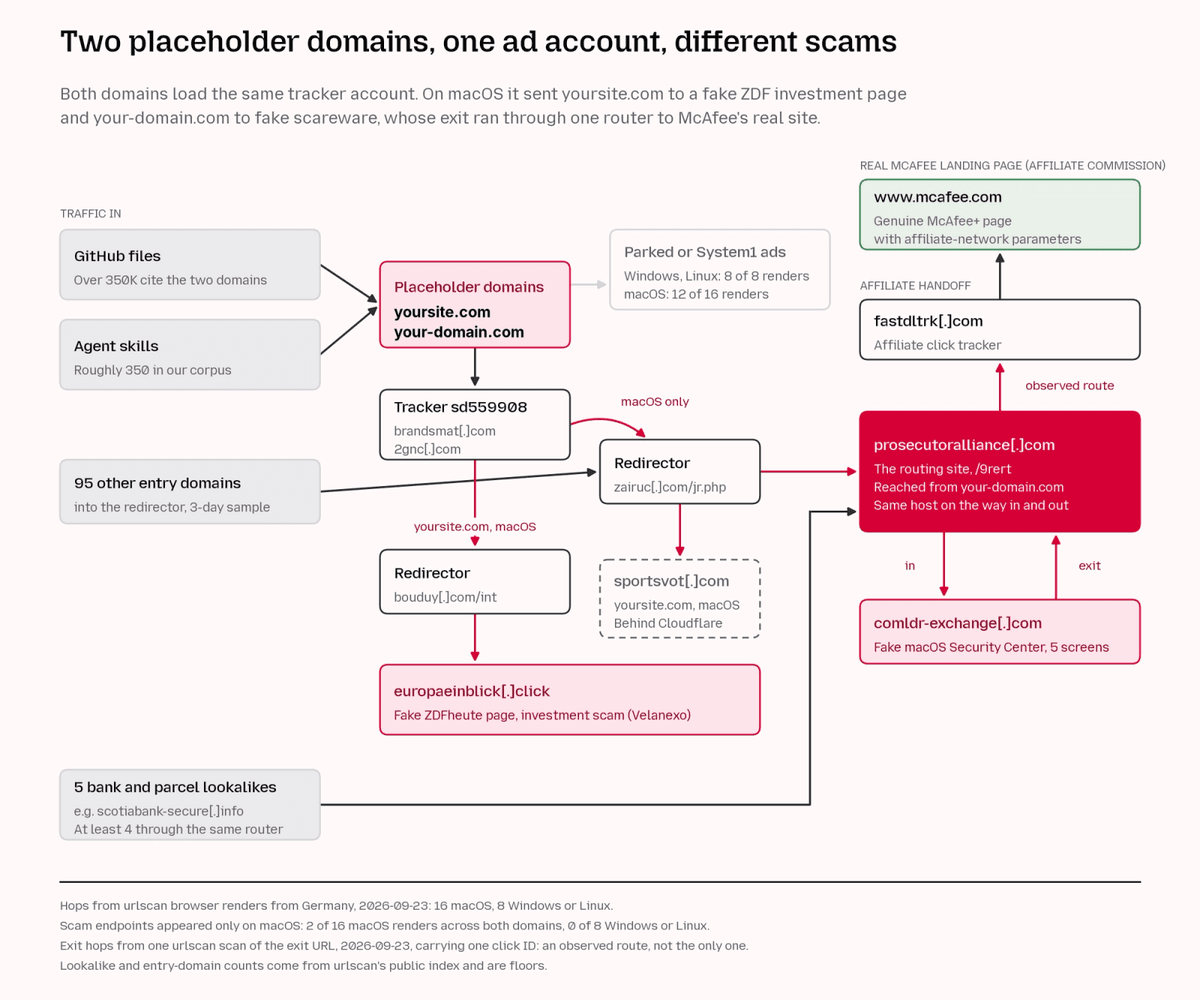
Manifold’s report revealed that its researchers tested the two domains across 24 real-browser sessions. Twenty visits ended on parking pages or ordinary ads, one hit a Cloudflare challenge, one failed to load, and two reached scams. The scam pages appeared only during macOS testing; none of the eight Windows or Linux renders reached a scam.
One macOS visit to your-domain.com showed a fake “MacOS Security Center” warning claiming four viruses and promoting a counterfeit McAfee renewal at 55% off. Its five screens included a fake security alert, virus list, scan result, progress bar, and countdown before an obfuscated JavaScript function redirected the browser.
That function loads a tracking pixel and sends the visitor to prosecutoralliance.com, which can pass the visitor to an affiliate tracker and, in one observed case, a genuine McAfee landing page. The redirect chain appears designed to generate affiliate commissions from fraudulent referrals.
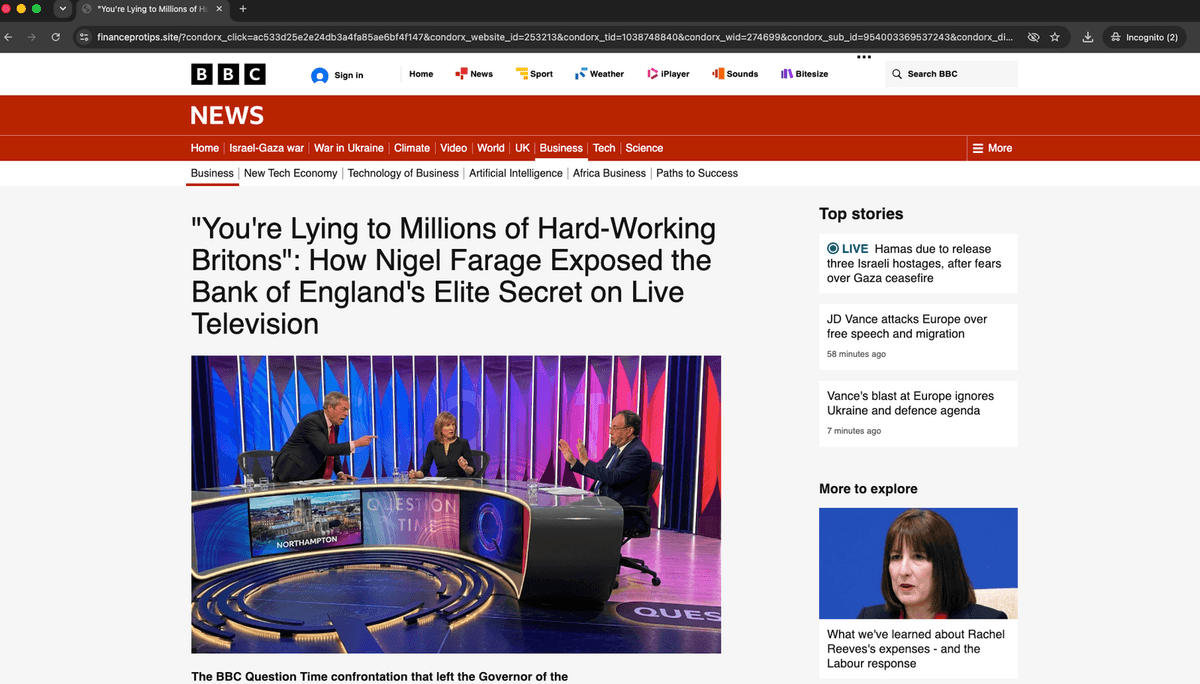
A separate macOS visit to yoursite.com reached europaeinblick.click, a fake ZDFheute article promoting an investment scheme through a fabricated talk-show confrontation. Manifold also observed a counterfeit BBC News article carrying a similar investment scheme after a visit to your-domain.com.
Why Static Checks Missed Them
Manifold’s static checks, including registry RDAP lookups, blocklist history, and 52-request probes using different User-Agent strings, cleared all 13 unreserved placeholder domains it examined. The scam redirect appears only after JavaScript runs in a real browser, while the destination is assembled from URL parameters at runtime.
The finding follows Manifold’s September 23 disclosure that another unreserved placeholder, third-party.com, had been turned into a ClickFix lure targeting Windows users. Its fake verification page copies a PowerShell command to the clipboard and tells victims to paste it into the Windows Run dialog.
These cases show how non-reserved domains used as documentation placeholders can become a security problem after their content or ownership changes. The original documentation does not need to change for an existing link to begin directing users to scams. Developers and AI tools that rely on older documentation should therefore treat unreserved placeholder URLs with caution.


