



Press play to start listening
When I examine how we teach children today, I see a system created for a different era. Primary education was designed for the 20th century, when memorization, standardization, and industrial models of learning aligned with the world outside the classroom. However, we no longer live in that world. Children today are growing up in an era where artificial intelligence is no longer just an abstract concept; it is a daily co-pilot in how we live, work, and connect. Our schools need to reflect this new reality.
Why the Current System No Longer Works
Traditional schooling assumes that knowledge is scarce and must be delivered in set units. It measures success by how much a child can recall in an exam. That made sense when access to information was limited. But today, information is abundant. AI systems can retrieve, summarize, and contextualize knowledge faster than any textbook or teacher lecture. The skills that matter most are creativity, adaptability, and the ability to apply knowledge in novel situations.
Yet, many classrooms still look like they did fifty years ago. Rows of desks, standard tests, and rigid curricula dominate. We are preparing children for jobs that will not exist while ignoring the reality that AI will shape every aspect of their future.
A New Philosophy: AI as the Matchmaking Engine
I believe the future of primary education rests on a simple idea: people, content, and opportunities already exist in abundance. The missing element is the engine that connects them in real time to every child’s needs. That engine should be AI.
In an AI-native education, technology would not reduce learning to a set of apps. Instead, it would act as the ultimate guide, constantly adjusting pathways so that each child learns in a way that fits their curiosity, pace, and strengths.
Research already shows that AI in education can enhance personalization, improve efficiency, and support inclusive classrooms. If Montessori emphasized discovery, the AI-native model emphasizes personalization at scale. The goal is not rote memorization, but unlocking creativity, fostering lifelong adaptability, and providing global access to education that is equitable for every learner.
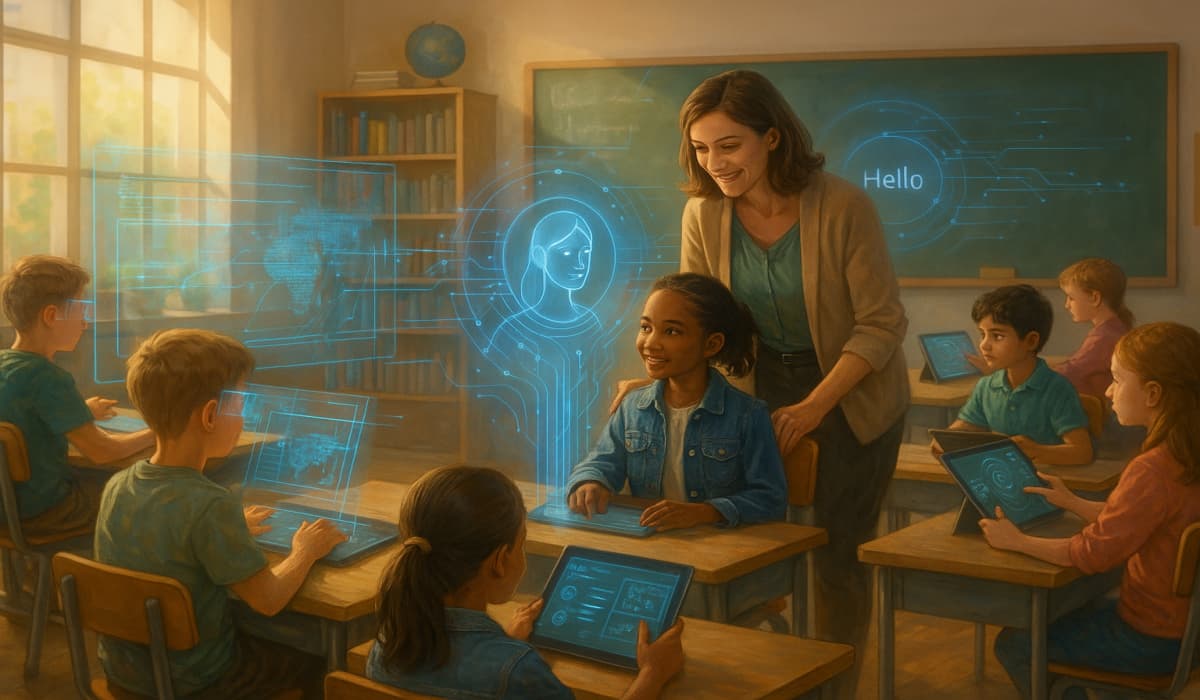
Imagine a classroom where a child fascinated by space gets connected to live data from telescopes, a conversation with an astrophysicist, and a curated set of math problems linked to orbital mechanics.
Another child who loves storytelling could be guided toward global narratives, virtual collaborations with peers across countries, and AI-generated writing prompts tailored to their reading level. The resources are already out there. AI makes them accessible, relevant, and connected.
Universal Access: A Global Imperative
We cannot ignore the global inequality in education. According to UNESCO, millions of children remain out of school or attend classrooms where quality learning is out of reach. Building an AI-native universal primary school is not just a vision for advanced economies. It is an opportunity to democratize access to opportunities for children in rural villages, urban centers, and even conflict-affected regions worldwide.
AI can provide personalized learning to students regardless of their location. With the proper infrastructure, a child in a remote mountain village, a refugee settlement, or an underserved neighborhood in a global capital could access the same level of tailored instruction as peers anywhere else. This is about breaking the cycle where geography, income, or circumstance dictate educational destiny.
Redefining the Role of Teachers
Teachers will remain at the heart of learning, though their role is evolving. In an AI-native school, educators move away from traditional lecturing and become mentors, facilitators, and emotional anchors. AI takes care of routine tasks, grading, monitoring, and adapting, so teachers can focus on what makes learning deeply human: empathy, inspiration, and real‑world connection.
This shift isn’t theoretical. As far back as 1972, the PLATO system demonstrated the potential of computer-assisted instruction to complement, rather than replace, teachers by automating routine tasks, such as testing and pattern matching, while human teachers remained essential for deeper understanding and guidance. That early precedent continues today: modern AI systems free educators to spend more time nurturing curiosity, supporting emotional growth, and guiding project-based learning.
Preparing Children for an AI-Driven World
The outcomes of an AI-native universal primary school are not just academic; they also encompass social and emotional development. They aim to equip children with critical thinking, resilience, and the confidence to collaborate with both humans and machines.
Preparing children for this world requires schools to act faster than current adoption trends suggest. According to the HolonIQ Global Executive Panel, only 1 in 10 education organizations had deployed AI, while nearly 20% were running pilots and about 30 percent had no plans at all. This slow progress shows that most systems were still experimenting with AI rather than redesigning learning around it. If we want children to thrive in the AI era, universal primary education cannot wait for adoption to catch up.

When AI manages knowledge delivery, children gain the freedom to focus on real-world problem-solving, experimentation, and collaboration. They also learn adaptability, which will be the most critical skill in an unpredictable future. By moving beyond pilots and partial adoption, schools can prepare every child to grow up as a confident partner to AI, not a passive user.
Learning from Historical Models
Education reform is not new. Montessori schools emphasized discovery. Waldorf schools highlighted imagination and the arts. Each model reflected the needs of its time. Our era now demands a model that embraces AI not as an accessory, but as a foundation for how children learn.
This shift aligns with a larger global movement. As shown in HolonIQ’s Global AI Strategy Landscape (2019), more than 30 countries had already launched national AI strategies. Most of these strategies were focused on innovation, inclusion, and preparing societies for AI-driven economies. Yet few gave equal attention to how primary education should evolve in an AI world.

An AI-native universal primary school is the logical evolution in this history. Just as Montessori redefined learning for industrial societies and Waldorf emphasized creativity for the modern age, today we must design schools that reflect the AI transformation already underway at the national and global levels. This ensures children are not just consumers of AI but active participants in shaping the future.
Addressing the Misconceptions
It is important to clarify what this vision is not. It is not about robots teaching kids. It is not about reducing education to screen time or replacing teachers with software. That dystopian framing misses the point.
The AI-native school is about creating a system that allows children to have the best of both worlds. They have human guidance and AI support. They engage with real content, real people, and real opportunities, but through pathways that are uniquely theirs.
The Policy and Investment Opportunity
For policymakers, the case is urgent. If education systems remain tied to outdated models, we risk creating a generation unprepared for the challenges and opportunities of the AI era. Countries that move first in creating AI-native universal primary schools will gain a significant advantage.
For edtech founders and investors, this is not just another app or tool. It is about reimagining the infrastructure of learning itself. Despite the disruption caused by COVID-19, Stanford’s 2021 AI Index reported that private investment in AI grew significantly in 2020. The winners in education will be those who channel this momentum into platforms that connect children to people, content, and opportunities in a seamless and responsible manner.
Parents, too, have a role. By advocating for systems that prioritize creativity and adaptability over test scores, they can help shift demand toward schools that embrace this vision.
The Future of Education
When I think of the future of education, I envision a child anywhere in the world logging into their personalized learning environment and finding it tailored just for them. Every day is a journey guided by AI, supported by teachers, and filled with opportunities that feel both exciting and relevant.
This is not science fiction. The technology exists. The resources exist. What is missing is the decision to build education systems around this new reality. The 20th century gave us universal primary education as a social contract. The 21st century must provide us with an AI-native universal primary school as the next stage of that contract.
It is the bold vision we need if we want every child to unlock their full potential.
References
- Cornell University. (February 2021) Artificial Intelligence Technologies in Education: Benefits, Challenges, and Strategies of Implementation. https://arxiv.org/abs/2102.09365
- Holon IQ. (March 30, 2019) Adoption of AI in education is accelerating. Massive potential, but big hurdles remain. https://www.holoniq.com/notes/ai-potential-adoption-and-barriers-in-global-education
- Holon IQ. (May 24, 2019) HolonIQ’s Annual Report: 2019 Artificial Intelligence & Global Education Report. https://www.holoniq.com/notes/2019-artificial-intelligence-global-education-report
- The Association of Waldorf Schools of North America. (n.d.) What Is Waldorf Education? https://www.waldorfeducation.org/what-is-waldorf-education/
- The New Yorker. (July 8, 2014) Will Computers Ever Replace Teachers? https://www.newyorker.com/tech/annals-of-technology/will-computers-ever-replace-teachers
- The Stanford Institute for Human-Centered AI. (March 3, 2021) The 2021 AI Index: Major Growth Despite the Pandemic. https://hai.stanford.edu/news/2021-ai-index-major-growth-despite-pandemic
- UNESCO. (June 2020) New UNESCO Report shows extent of global inequalities in education and calls for greater inclusion as schools re-open. https://www.unesco.org/en/articles/new-unesco-report-shows-extent-global-inequalities-education-and-calls-greater-inclusion-schools-re