




Press play to start listening
Traditional privileged access management (PAM) was built for human users. Today, AI agents increasingly operate alongside those users, logging into enterprise apps and handling sensitive data with privileged access of their own. Securing them takes modern PAM, built for how agents actually work.
growing share of enterprises now deploy AI agents that act with increasing autonomy. They log into critical systems and infrastructure and access sensitive data, stirring up a hornet’s nest of security risks. Agents can be compromised or manipulated through prompt injection. Even “loyal” agents can veer off track and cause significant damage if they’re granted excessive permissions.
These agentic systems don’t have the human ability to evaluate risk, but they’re often still managed by the same PAM systems. The password vaults that lie at the heart of traditional PAM were designed to protect, store, and control privileged credentials which are granted or revoked for human workers.
Traditional PAM added session controls over the years, but those controls assume there’s a human at the keyboard. And in many organizations, PAM still amounts to a vault and a rotation schedule. Neither was built to control how an AI agent uses the privileges it’s granted.
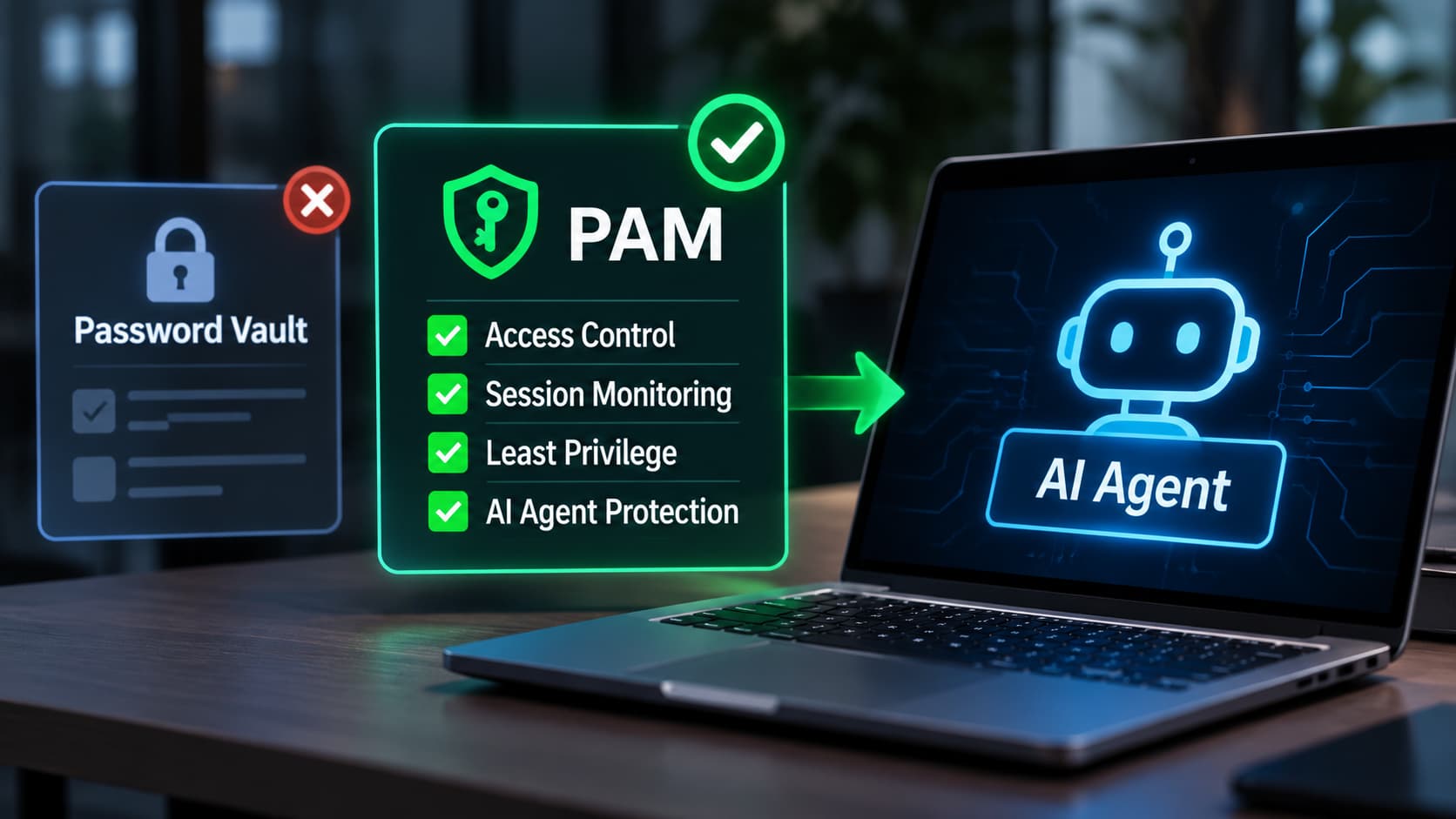
Modern PAM treats agents as privileged users in their own right. AI agents need dynamic, granular access controls which grant privileges just in time and revoke them as soon as the task is done. Systems should monitor activity for risky behavior and act instantly when agents provoke suspicions.
This article discusses the ways that modern PAM moves beyond credential storage to govern privileged activity for the entirety of an agent’s access lifecycle.
Dynamic Permissions Eliminate Standing Privileges
Password vaults store and generate credentials, including credentials for persistent access. Granting persistent access to agents which act without specific human approval or oversight can be extremely risky.
AI agents act at a speed and scale that are way beyond human capability. They can execute actions across multiple systems in minutes and work around the clock, causing more damage than a similarly privileged human worker. Agents also open new paths to compromise, as attackers can use prompt injection to manipulate an agent into abusing permissions, without having to steal credentials.
With modern PAM, access can be granted on a just-in-time (JIT) basis. Agents are given temporary privileges that last as long as the task at hand. Once an agent has completed an action, privileges are revoked. The workflow is automated to remove manual friction. When humans have to approve every request to grant or revoke access, there’s a risk that they’ll authorize standing permissions to save time. Automation removes that stumbling block so that security policies are consistently enforced.
Least-Privilege Access Restricts Agent Actions
Credential protection doesn’t equate to permission controls.
Password vaults generally protect secrets, so they’ll only grant an agent the credentials that they are authorized for. But they won’t necessarily restrict what agents can do with that access. Modern PAM scopes permissions to the actions the agent actually needs to perform.
For example, a password vault might hand an agent credentials for a database account with full read, edit, and delete rights, even though the task only needs read access. A modern PAM system could use predefined policies, identity context, or security integrations to grant it read-only permissions so that it can’t step outside its remit.
Individual Identities Enable Accountability
The main task of password vaults is to manage credentials. They don’t always distinguish between the agents that use those credentials or keep track of what they do with them. If you have multiple agents working together, it can be very difficult to know which one actually accessed a system or carried out an action.
When everything goes smoothly, that’s not a problem, but if you have to audit a breach, you need to be able to trace actions to the agent responsible.
In contrast, modern PAM can associate privileges with individual identities. Each agent can be given distinct access policies and their actions can be monitored and attributed on a granular level. This way, you can see if just one agent is behaving suspiciously or seems to be compromised, and revoke permissions for that one agent without disrupting the others.
Activity Monitoring Spots Suspicious Behavior
Password vaults generally log when someone retrieves a credential, the time when it was accessed, and sometimes what they intend to do with it. That’s about as far as their monitoring goes. They have little to no visibility into what an AI agent actually does afterwards, but AI agents move autonomously, and extremely quickly.
If security teams can only see authentication events, they’ll be mostly blind to what agents are actually doing. Modern PAM monitors and records what the agent does during privileged sessions. Solutions can track privileged activity across systems, apps, and databases, to detect unusual behavior that might be suspicious.
Some modern PAM platforms automatically record specific operations like accessing sensitive files, modifying configurations, or deleting records.
Real-Time Intervention Acts Upon Risks
That said, monitoring on its own isn’t enough. You also need to be able to step in and intervene as soon as any signals of risky behavior are detected.
The best that password vaults can do is to rotate passwords and revoke credentials so that an agent is blocked from future access. But this doesn’t necessarily curtail an existing session or invalidate an access token, which means that a rogue AI agent can carry on operations even after the credentials are revoked.
Modern PAM has much more control over active sessions. Some solutions can terminate sessions straight away, or prevent an agent from carrying out specific suspect operations even when the session is still ongoing. They can also revoke temporary privileges and cancel tokens. This way, AI agents have much less leeway to exploit existing privileges.
Modern PAM Is Designed for AI Agent Security
Password vaults have done a solid job of securing secrets and managing credentials for human workers. But AI agents need more than a vault. They need modern PAM built with agents in mind. Modern PAM solutions can dynamically grant and revoke permissions, keep privileges to the minimum, and monitor and act upon suspicious behavior to prevent AI agents from abusing privileges.