






Press play to start listening
Researchers demonstrated PhantomTac, an attack using hidden magnetic tags to trick robotic touch sensors and make robots drop objects or damage them with force.
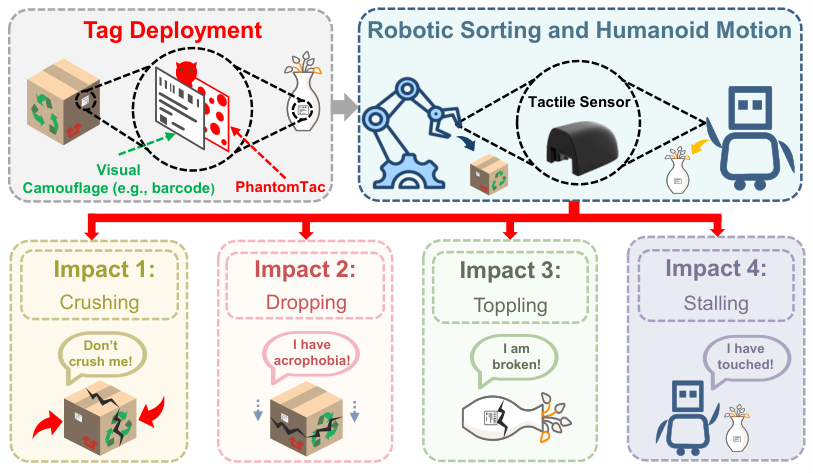
A small magnetic tag attached to an object could fool a robot’s magnetic touch sensors, causing it to drop an item, squeeze it too hard or misjudge physical contact.
The details of this attack, called PhantomTac, are described in a research paper by Binbin Zhang, Yifeng Zhang, Xiaomeng Chen, and Dongyao Chen. The paper was posted on October 19 and accepted for the ACM Conference on Computer and Communications Security (CCS) 2026, scheduled for November 15–19 in The Hague, Netherlands.
How PhantomTac Manipulates Sensor Readings
The technique was tested on commercial tactile sensors and real robotic systems. Magnetic tactile sensors detect pressure by tracking changes in a magnetic field as their sensing layer bends or compresses. They measure normal force, which pushes against a surface, and shear force, which acts along the surface.
PhantomTac exploits a limitation in this approach: a small magnet close to the sensor creates a localized magnetic field that may not be cancelled out. The resulting signal can be mistaken for a change in contact force, misleading the robot’s control system.
The researchers developed passive battery-free magnetic tags around 0.5 millimeters thick, with an area as small as 1.44 square centimeters. These can be concealed beneath barcode or QR-code stickers. An attacker needs brief access to an object or its packaging, along with knowledge of the target sensor model, but does not need access to the robot’s software or control system.
Tests Show Risks to Robotic Handling
Researchers evaluated several PaXini sensor models and a XELA uSPa 46 sensor, but used only PaXini hardware for the robotic demonstrations. For context, PaXini and XELA are manufacturers of robotic touch sensors.
The tested models use magnetic fields to measure contact forces, helping robots judge how firmly they are gripping or pressing against an object. Researchers also fitted a Dofbot-Pi4B robotic arm with a magnetic touch sensor to test whether the tags could make its gripper drop or damage an object.
In grasping tests, the attack succeeded more than 95% of the time when the contact position was within 8 millimeters of the intended tag placement.
When the sensor reports more pressure than the robot is actually applying, the robot can start moving before it has a firm grip and drop the item. If the sensor reports too little pressure, the robot can keep squeezing until it damages the object. The paper also examines how false readings of sideways force could weaken its grip.
PhantomTac makes the Dofbot-Pi4B robotic arm underestimate gripping force, causing its gripper to keep closing and crush the object. Video courtesy of the researchers.
PaXini and XELA are manufacturers of robotic touch sensors. The tested models use magnetic fields to measure contact forces, helping robots judge how firmly they are gripping or pressing against an object. In a separate test, a Unitree G1 humanoid robot registered contact before touching a vase or failed to stop before pushing it over, depending on the false reading.
PhantomTac causes the Unitree G1 robot to underestimate contact force, delaying collision detection and causing the vase to topple. Video courtesy of the researchers.
The findings echo a separate study, GhostTac, which examined how electromagnetic interference could manipulate tactile sensors without physical contact. Both studies highlight the risks of relying on potentially manipulated touch readings.
Researchers suggest checking touch readings against motor current, joint torque and movement to identify inconsistent signals. They did not evaluate this proposed defence experimentally. The paper demonstrates controlled attacks, not incidents involving deployed robots.


