





Press play to start listening
The highly anticipated Pwn2Own Berlin 2026 hacking competition concluded on 16 May 2026, following three days of intense activity at the OffensiveCon conference, and we have all the results. The event saw massive financial payouts, with researchers receiving around $1,298,250 in total for live demos of 47 unique zero-day vulnerabilities.
The Top Three Teams
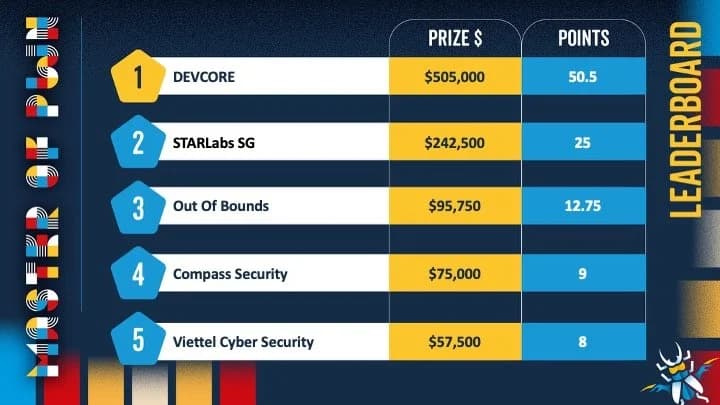
A Taiwanese research group, DEVCORE, was awarded the Master of Pwn title, receiving 50.5 points and $505,000 in cash rewards, while STARLabs SG secured second place with 25 points ($242,500), followed by Out Of Bounds in third with 12.75 points ($95,750).
The competition’s largest payout went to the DEVCORE Research Team’s Cheng-Da Tsai, aka Orange Tsai, who received $200,000 for chaining three different vulnerabilities to achieve remote code execution (RCE) with SYSTEM privileges on Microsoft Exchange. On the event’s opening day, Tsai had earned $175,000 for a Microsoft Edge sandbox escape that chained four logic bugs.
Key Exploits
At Pwn2Own Berlin, researchers targeted fully patched products from diverse categories, including local privilege escalation (LPE), virtualization, and Large Language Model (LLM) coding assistants.
On the final day, Nguyen Hoang Thach of STARLabs SG successfully used a memory corruption vulnerability to exploit VMware ESXi with the Cross-tenant Code Execution add-on, earning $200,000. Also, splitline from DEVCORE chained two bugs to compromise Microsoft SharePoint, netting $100,000.
Operating systems were repeatedly targeted throughout the event. Le Tran Hai Tung, dungnm, and hieuvd of Viettel Cyber Security used an integer overflow to achieve local privilege escalation (LCE) on Windows 11.
Another repeatedly breached platform was Red Hat Enterprise Linux for Workstations. Reportedly, researcher Hyunwoo Kim chained a use-after-free bug and an uninitialized memory vulnerability to gain privilege escalation. Valentina Palmiotti of IBM X-Force Offensive Research achieved root access on the platform and also exposed a 0-day in the NVIDIA Container Toolkit.
AI-based Exploits
The newly introduced artificial intelligence categories also faced successful exploitation. Satoki Tsuji of Ikotas Labs, Inc., abused an external control vulnerability within OpenAI Codex to execute arbitrary code on the host system.
Anthropic Claude Code AI assistant was also targeted multiple times. Researchers from Compass Security and Byung Young Yi of Out of Bounds successfully demonstrated exploits against it, but both attempts resulted in bug collisions because the underlying vulnerabilities had already been previously disclosed to the ZDI vendor database.
This year, the event faced a controversy over an unlikely logistical challenge, as for the first time in its 19-year history, the contest ran out of slots. As reported by Hackread.com earlier this month, the Zero Day Initiative (ZDI), the Trend Micro organisation that operates the event, had to close registrations on 7 May due to the registration logjam, which led to revenge disclosures from the rejected candidates.
Nevertheless, the event was successful. Now, as per the standard disclosure guidelines, vendors have a 90-day window to develop/distribute security patches, after which ZDI will release the technical specifics of the identified zero-days.