



Press play to start listening
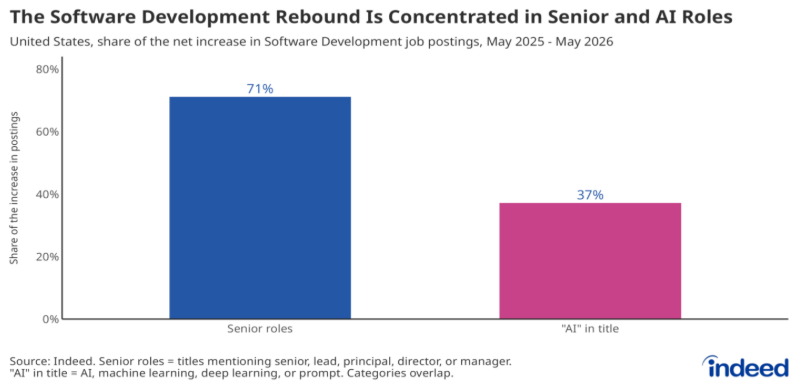
US software development job postings on Indeed rose nearly 15% from late February 2025 through the period covered by its July 2026 analysis, while overall US job postings fell 7%. Senior roles accounted for 71% of the increase in software development postings between May 2025 and May 2026, according to Indeed Hiring Lab. Roles with AI in the job title accounted for 37% of the increase over that same year.
Software development postings were still about 27.5% below their pre-pandemic level. The figures show where demand has returned on Indeed, but they don’t tell us how many people companies hired or whether AI caused the rebound.
Alejandro Gomez, founder and CEO of Zaga, which places engineers from Latin America in US product teams, said his clients now expect more from the engineers they hire. “AI didn’t reduce our clients’ appetite for engineers. It raised their standard for them,” he said.
The rebound in postings has favoured senior roles
The US Bureau of Labor Statistics projects that software developer employment will grow 15.8% between 2024 and 2034, adding 267,700 jobs. That is a forecast for the profession; it does not measure how many jobs AI has already changed or replaced.
The picture looks different for people entering the workforce. In an August 2026 update, Stanford Digital Economy Lab researchers estimated that employment among workers aged 22 to 25 in occupations highly exposed to AI was 19% below where it would have been had it kept pace with employment among less-exposed workers of the same age. Experienced workers showed no comparable gap. The study covers several occupations, including software development, and does not establish AI as the sole cause.
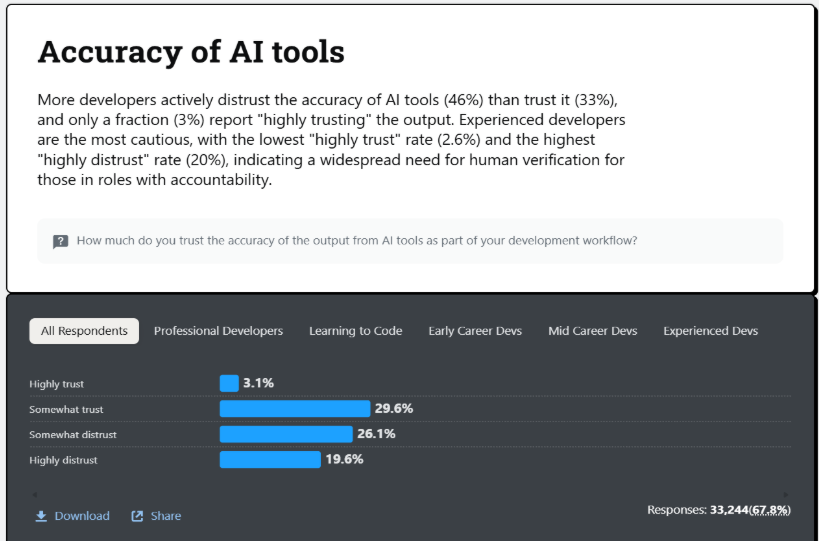
Developers trust AI output when they can check it
In Stack Overflow’s 2026 Developer Survey, 48% of respondents to the trust question said they trusted AI output when they could easily verify it. About 7% said they trusted it for many tasks, including important work decisions.
Google’s 2025 DORA report found that 90% of the technology professionals it surveyed used AI at work, while 30% reported little or no trust in AI-generated code. The report found that AI tended to magnify a team’s existing strengths and weaknesses. If a team already struggles to review and test changes, generating more code gives it more work to check.
What AI fluency looks like on an engineering team
An engineer who uses AI well can explain why a proposed change belongs in the codebase, test what happens when inputs are missing or unexpected, and spot issues such as a permission check the generated code left out. The engineer also needs to know when to discard a suggestion and write the change from scratch.
Employers are asking for both technical and communication skills. ManpowerGroup’s Q4 2026 Experis Tech Talent Outlook found that employers were prioritising AI capabilities alongside the skills needed to work with others. In an engineering team, those skills show up when someone can explain what they tested, what remains uncertain and why a change is ready to release.
A practical interview exercise is to give candidates a short piece of AI-generated code and ask what they would test, what they would change and whether they would ship it. Pay attention to the evidence they ask for before they say yes.
(Photo by Growtika on Unsplash)