





Press play to start listening
F5 has released security updates for two critical vulnerabilities in NGINX, the open-source web server owned and maintained by F5, powering more than 225 million websites.
These vulnerabilities can allow attackers to execute code on affected servers without authentication, exposing websites, APIs and the applications running behind them. The flaws are tracked as CVE-2026-123007 and CVE-2026-123633 with a CVSS score of 9.2.
What’s interesting is that they were independently investigated and reported to F5 by five research teams, including Wiz Research, Ikotas Labs, Metnir, Rapid7 and Xint. Per their findings, both flaws are in NGINX’s HTTP/2 implementation and not in the websites or applications using the software.
Wiz’s research, shared with Hackread.com, provides a detailed overview of the security impact of the issue. Wiz researchers used the AI-powered Wiz Atlas platform to identify the flaws and Gemini 4 Carbon and ChatGPT 5.6 Sol to validate their findings.
They successfully carried out remote code execution (RCE) on official NGINX 1.31.7 and 1.31.8 builds. This included a server delivering ordinary static files without a backend application or third-party modules. Both vulnerabilities, however, require HTTP/2 to be enabled on the affected server.
The NGINX disclosures come just a day after the discovery of Java4Shell (CVE-2026-114938)- a critical OpenJDK vulnerability reported by Calif that can also lead to unauthenticated remote code execution.
The Vulnerabilities
CVE-2026-123007 is an integer underflow in HTTP/2 flow-control accounting. It affects versions dating back to NGINX 1.9.5, released in 2015. Incorrect handling of unused data allowances can eventually cause an out-of-bounds memory operation.
The other flaw, CVE-2026-123633, is a use-after-free vulnerability affecting versions 1.19.7 to 1.31.8. It can occur during reverse-proxy processing when NGINX runs low on available connection slots.
NGINX is a recurring target
This isn’t the first time NGINX has faced attacks involving AI-assisted vulnerability research. In May, Hackread.com reported attacks exploiting NGINX Rift (CVE-2026-42945). That flaw was different, though, because it required a specific, non-default rewrite configuration and mainly exposed servers to denial-of-service (DoS) attacks, whereas RCE was possible only when ASLR was disabled or bypassed.
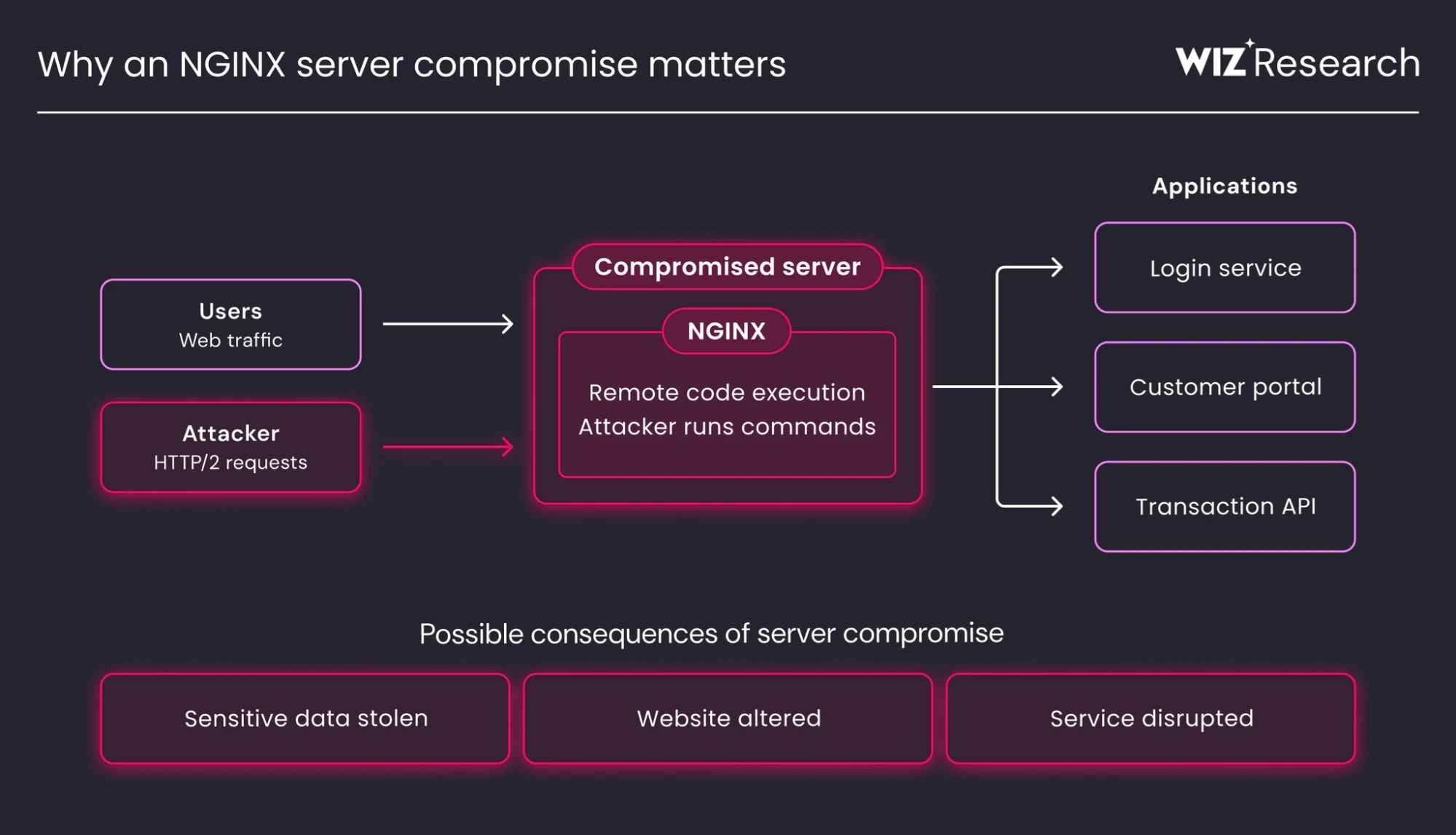
The latest vulnerabilities are far riskier because they let unauthenticated attackers execute code on affected servers. A successful attack can give them control over systems handling traffic for multiple websites and applications and this would put customer data and services at risk.
Patches and Updates
In its November 18 security update, F5 addressed ten NGINX vulnerabilities, including additional flaws affecting HTTP/3, the DNS resolver and mail proxy modules, and issues that could cause DoS or other security problems. The fixes address both critical HTTP/2 flaws.
Administrators should update NGINX Open Source to 1.30.7 (stable) or 1.31.9 (mainline). NGINX Plus users should install the applicable fixed version: 37.0.7.1, 37.0.8.1, 37.2.0.1, or 37.3.0.1.
Those unable to upgrade immediately should temporarily disable HTTP/2 using http2 off in affected server blocks.
For defenders, the key takeaway is that finding vulnerabilities is only half the job; now, they also need to identify affected systems and get the fixes installed before attackers can exploit them.