




Press play to start listening
The FBI is warning about a new framework, ARTEX, which automates several stages of a cyberattack, from finding targets to stealing data.
In a November 13 Flash Advisory, the Federal Bureau of Investigation (FBI) said cybercriminals had been using the open-source framework since at least August 2026 to target organizations worldwide. The targeted sectors include financial services, government, technology, defense, healthcare, semiconductor, energy, manufacturing, telecommunications and legal services.
One confirmed incident involved a supply-chain compromise of ConnectWise Cloud Backup that allowed attackers to access more than 2,250 downstream tenants.
Written in Go, ARTEX connects to external large language models (LLMs) like DeepSeek, Claude and GPT. What makes it different is its use of specialized AI agents that work on separate tasks after an operator sets an objective. These agents can identify targets, check systems for weaknesses, exploit them and exfiltrate data, with little human involvement.
The FBI says (PDF) some attacks have moved from initial targeting to privileged access in less than three hours and that DeepSeek Flash models are particularly popular among attackers because of their relatively low cost and lack of observable safety guardrails for penetration testing.
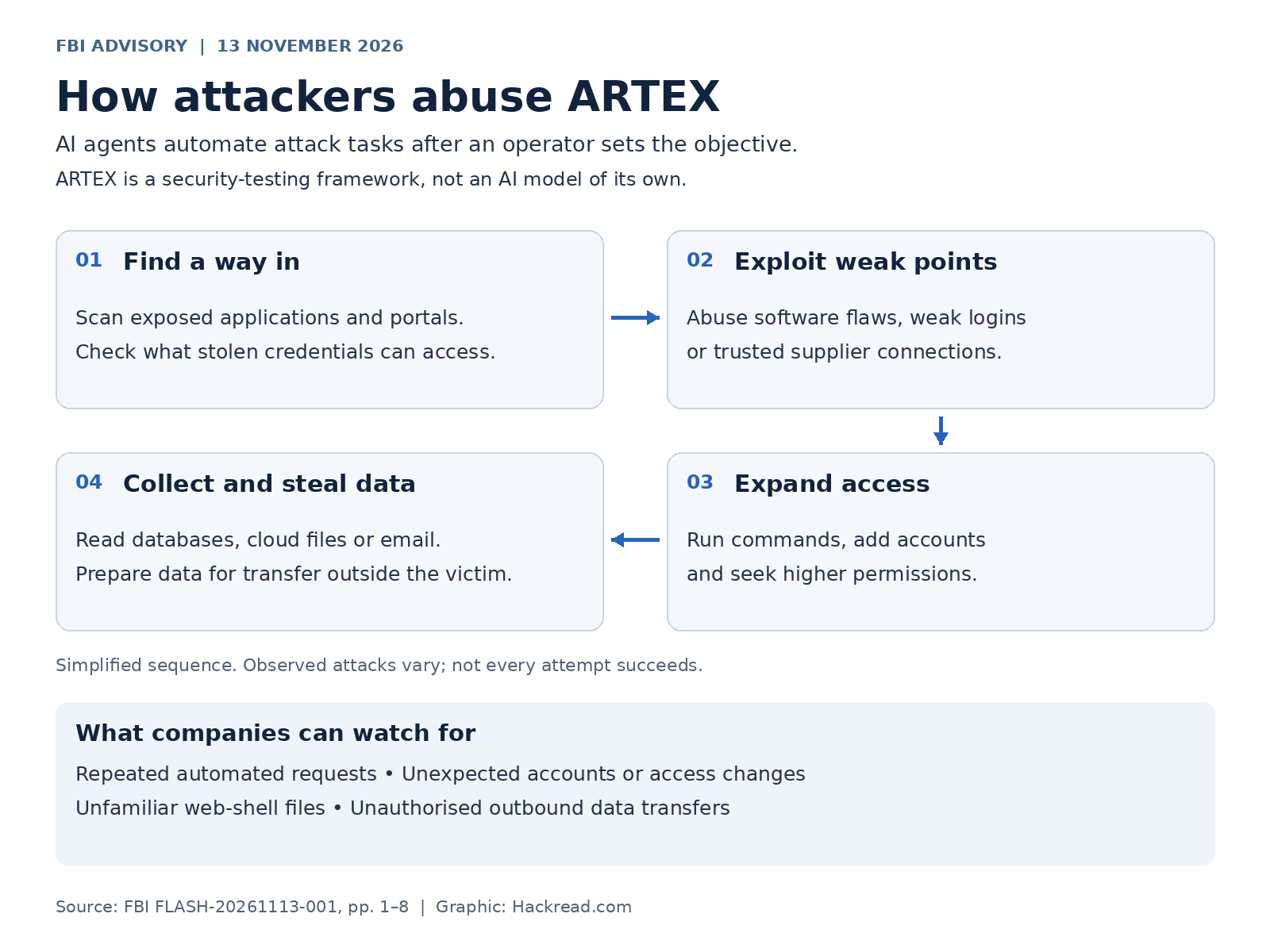
The problem goes beyond faster attacks
Some ARTEX-assisted intrusions have reached privileged access in less than three hours. That leaves security teams little time to investigate an intrusion before attackers move further into a network. The ConnectWise incident shows how this can affect other organizations.
Microsoft’s investigation into Artex linked the activity to Storm-0940, a China-aligned threat group. After compromising ConnectWise applications, the attackers used the access to target customer environments. Microsoft also recorded more than 151,000 failed sign-in attempts during a related campaign, with activity reaching 2,900 attempts per minute.
The FBI also highlighted attacks against South Korean financial institutions in which personal information of around 67,000 people was stolen. Impacted banks included Shinhan, KB Kookmin, Hana, BNK Busan Banks, Hyundai Capital, Yegaram Savings Bank, and Welcome Savings Bank among others.
These findings highlight the gradual change in the way attackers are using AI. Hackread.com previously reported on a PaperCut campaign in which hundreds of AI agents helped attackers develop, troubleshoot and scale the exploitation of two zero-day vulnerabilities. ARTEX brings several attack stages together in a single framework. This further reduces the work needed to move between them.
Google’s threat intelligence team has also reported malicious use of other agentic frameworks, including CAIRN and PentAGI. Its findings suggest that these operations can be noisy and relatively unsophisticated but still successful because of their speed and scale.
Taking down the original tool did not end its use
ARTEX’s developer, Autumn-27, removed the original GitHub repository on October 8, 2026, following reports of abuse. But copies, community forks and a commercial version called ARTEX PRO remain available with more than 1,600 publicly exposed ARTEX consoles identified by early November.
The FBI is seeking authentication records, API activity, cloud logs and other evidence of ARTEX-related attacks.
The FBI’s findings have also raised concerns about how organizations manage exposed systems, credentials and access between suppliers. Morey J. Haber, Chief Security Advisor at BeyondTrust, shared with Hackread.com that ARTEX changes the time and expertise needed to turn discovered weaknesses into working attacks.
“The truth, however, is not about a new exploit or zero-day vulnerability developed by AI. It is the collapse of the time and the expertise barrier between what is discovered and when it is weaponized. Threat actors have long known that the weakest link is not always on a flagship application. A successful breach can occur in a partner portal, a legacy service, a backend mobile application, or a forgotten third-party integration. Until now, finding and chaining those dependencies took effort, talent, and time. ARTEX industrializes these concepts.”
Haber also warned that organizations should pay closer attention to identities and credentials used by applications and automated services, not just employee accounts.
“ARTEX is not breaking in so much as logging in with keys it finds lying around, including machine identities and service accounts that nobody is monitoring or that have been forgotten about. And since it maps trust between organizations, your risk is only as strong as your weakest supplier. Put simply, the blast radius extends well beyond your own perimeter.”