






Press play to start listening
Healthcare apps increasingly connect patients with some of their most sensitive information, from medical records and prescriptions to diagnostic results and remote monitoring data.
This makes mobile security more than a technical requirement. A compromised application can affect patient privacy, regulatory compliance, trust, and, in some cases, the delivery of care.
For organizations investing in healthcare app development, security should therefore influence the product from the first architectural decisions rather than being added shortly before release.
Understand the Mobile Threat Surface
Healthcare apps face many of the same threats as other mobile products, but the consequences can be significantly higher because of the sensitivity of health data.
Once an application is installed, developers no longer fully control its environment. Attackers may attempt to intercept communications, steal credentials, manipulate the application, exploit insecure APIs, or analyze its code through reverse engineering. Malware on a compromised device can introduce another potential path to sensitive information.
A security strategy therefore needs to protect both patient data and the integrity of the application itself.
Protect Data at Every Stage
Encrypting the database is important, but healthcare information can be exposed at several points. It may be stored on a device, transmitted to a backend, processed by another service, or accessed through an administrative interface.
Teams should consider:
- encryption for data in transit and at rest;
- strong authentication and authorization;
- secure storage of credentials and tokens;
- reliable session management;
- API authentication and input validation;
- role-based access to sensitive information.
Access should follow the principle of least privilege. Patients, clinicians, administrators, and support teams should only reach the information necessary for their responsibilities.
Make the App Harder to Manipulate
Backend security alone cannot fully protect software running on an untrusted mobile device.
Code hardening can make reverse engineering more difficult, while runtime protection can help identify tampering, malicious behavior, or suspicious execution environments. Application integrity controls can also help detect modified versions of an app.
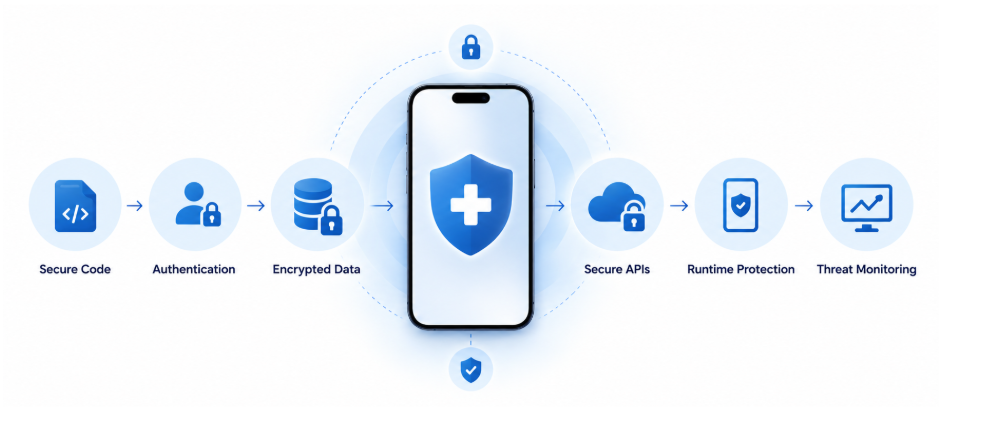
The principle is defense in depth. Instead of relying on one security mechanism, multiple controls protect different parts of the application and data flow.
Test Security Throughout Development
Security testing should happen throughout development rather than becoming a final pre-launch checklist.
Automated checks can identify vulnerable dependencies and common coding issues as the product evolves. More focused assessments can examine authentication, APIs, data storage, access controls, and potential attack paths.
Finding these problems earlier also reduces the likelihood of discovering architectural weaknesses immediately before launch, when fixing them becomes considerably more expensive.
Monitor What Happens After Launch
Publishing the application is not the end of its security lifecycle. Dependencies become outdated, new vulnerabilities appear, attack techniques evolve, and product updates create new functionality.
Post-launch security should include threat monitoring, dependency updates, vulnerability management, access reviews, and clear incident-response procedures. Security controls should also be reassessed as the application gains users, integrations, and new types of data.
Build Patient Trust Into the Product
HealthTech security ultimately supports something broader than compliance: confidence.
Patients need to trust that sharing medical information through an app will not unnecessarily expose it. Healthcare organizations need confidence that digital products will not introduce unacceptable risks into their systems.
The strongest approach is therefore to treat cybersecurity as part of the product lifecycle. Secure architecture, protected data flows, application integrity, continuous testing, and monitoring should evolve alongside the app.
(Photo by Samuel Regan-Asante on Unsplash)




Thank you for this article. Good info